edHelper.com
A New Nation
(1776-1830)

Monroe Doctrine


Monroe Doctrine
Reading Level
     edHelper's suggested reading level:   high interest, readability grades 5 to 6
     Flesch-Kincaid grade level:   5.17

Vocabulary
     challenging words:    happening, alliance, align, military, dealing, power, freedom, navy, join, country, trade, regain, fight, against, bold, control
     content words:    United States, Latin America, James Monroe, Monroe Doctrine


Print Monroe Doctrine
     Print Monroe Doctrine  (font options, pick words for additional puzzles, and more)


Quickly Print - PDF format
     Quickly Print: PDF (2 columns per page)

     Quickly Print: PDF (full page)


Quickly Print - HTML format
     Quickly Print: HTML


Proofreading Activity
     Print a proofreading activity


Feedback on Monroe Doctrine
     Leave your feedback on Monroe Doctrine  (use this link if you found an error in the story)


Monroe Doctrine
By Cathy Pearl
  

1     Americans were very happy when other countries started to win their freedom. The president wasn't happy. He was worried. These new countries had won their freedom from bigger countries in Europe. The president was afraid of what these bigger countries would do.
 
2     In 1815, four countries in Europe joined together. They made an alliance. They planned to stop any fighting that started near their countries. They also talked about helping Spain. They would even help Spain get some of the colonies back. Many of these colonies had already won their freedom.
 
3     Britain was also worried. It worried about the trading that they did with other countries. Britain was sure their trade would be hurt if Spain took over its colonies again. They thought the United States should join them. They would help the colonies in Latin America.
 
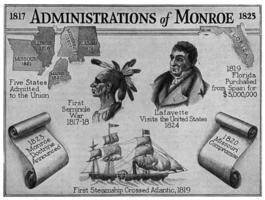
4     James Monroe was president at the time. He did not join with Britain. He made a bold move in 1823. He made a statement about how the United States would treat the colonies. This was called the Monroe Doctrine.

Paragraphs 5 to 11:
For the complete story with questions: click here for printable


Copyright © 2009 edHelper