edHelper.com
Crime and Terrorism


Anxiety


Anxiety
Reading Level
     edHelper's suggested reading level:   grade 6
     Flesch-Kincaid grade level:   8.17

Vocabulary
     challenging words:    agoraphobia, Obsessive-compulsive, posttraumatic, unrealistic, uncertain, anxiety, coping, separation, imbalance, tendency, life-threatening, attendance, reality, terrorist, social, happening


Print Anxiety
edHelper.com subscriber options:
     Print Anxiety  (font options, pick words for additional puzzles, and more)

     Quickly print reading comprehension

     Print a proofreading activity


Feedback on Anxiety
     Leave your feedback on Anxiety  (use this link if you found an error in the story)


Anxiety
By Jennifer Kenny
  

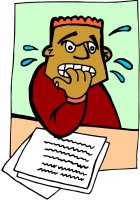
1     Have you ever felt uneasy and fearful? Of course you have. We all have. Perhaps you had to give a report to your class and were scared. Maybe you were afraid of the dark when you were younger. Maybe you were worried about a big test. It's perfectly normal to be apprehensive about different things at certain points in your life.
 
2     From the day humans are born, they experience different anxieties. Babies often cry when someone unfamiliar handles them. This is known as stranger anxiety. Toddlers are known for their separation anxiety. They often react with fear when their parents leave them even for a minute. Children from the age of 4 to 6 are often scared of monsters and ghosts. Older children, especially over the age of 7, worry about injury to themselves, natural disasters, or even terrorist attacks. Some fears people just grow out of. Some are learned based on experience like being afraid of dogs after being bitten by one.
 
3     So what is normal and what is not? All people feel fear at some point. Usually the feeling comes on when they have no control over what will happen next or if they feel threatened or in danger. A mild amount of fear can even be beneficial. If a person is worried about a test, hopefully that will motivate him to study. A fear of fire will hopefully keep a child from playing with matches. Anxiety is dangerous, though, when it becomes a disorder and interferes with normal functioning on a day-to-day basis.
 
4     So what happens when a person feels fearful because he is uncertain or in danger? The body reacts with a "fight or flight" response. In case the person needs a quick escape, the heart rate increases, more blood goes to the muscles and brain, and the lungs take in air faster.

Paragraphs 5 to 11:
For the complete story with questions: click here for printable


Copyright © 2008 edHelper