edHelper.com
The 1940's


Where Would We Be Without the Ballpoint Pen?


Where Would We Be Without the Ballpoint Pen?
Reading Level
     edHelper's suggested reading level:   grades 4 to 6
     Flesch-Kincaid grade level:   6.11

Vocabulary
     challenging words:    acceptable, ballpoint, compartment, inkwell, investors, jackpot, manufacturers, name-Bic, production, manufacture, elderly, version, reservoir, writing, design, great-grandparents
     content words:    John Loud, President Augustine Justo, United States Air Force, Eberhard Faber Company, Eberhard Faber, Eversharp Company, Milton Reynolds, In October, New York City, Papermate Company


Print Where Would We Be Without the Ballpoint Pen?
edHelper.com subscriber options:
     Print Where Would We Be Without the Ballpoint Pen?  (font options, pick words for additional puzzles, and more)

     Quickly print reading comprehension

     Print a proofreading activity


Feedback on Where Would We Be Without the Ballpoint Pen?
     Leave your feedback on Where Would We Be Without the Ballpoint Pen?  (use this link if you found an error in the story)


Where Would We Be Without the Ballpoint Pen?
By Jane Runyon
  

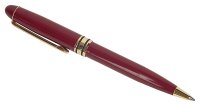
1     When your grandparents and great-grandparents went to school, they may have been taught to write with a pen made from sharp piece of metal stuck into the end of a carved piece of wood. They dipped this piece of metal into a bottle of ink. The pen tip had to be dipped over and over again into the ink. Some of the larger schools had the ink well built right into the desk. Sometimes boys thought it was funny to dip the pigtails of the girls sitting in front of them into the inkwell, too.
 
2     Your grandparents' grandparents and their great-grandparents probably used a feather whose tip had been sharpened to write with. Feathers were easier to find in those days than the sharpened metal tips their children used.
 
3     Back in 1888, a leather tanner named John Loud needed a pen that would write on leather hides. He didn't want to take the time to dip his pen several times. He decided that he could invent something to make his job easier. He came up with a roller-ball-tip marking pen. His pen had a compartment to hold extra ink. He called it a reservoir. He took a little metal ball and put it in the end of a tube. When he tipped the tube straight up, the ink flowed down and the metal ball rolled the ink onto the surface he wanted to write on. His idea never took off. He patented his invention, but he never produced any pens.
 
4     In the next thirty years, over 350 patents were issued using John Loud's basic idea. There was always a problem with the final product. If the ink was too thin, it would leak out of the pen and get all over everything. If the ink was too thick, it would not come out of the pen consistently. It left big clumps of ink on the paper.
 
5     In 1935, two Hungarian brothers took up the search for the perfect pen. In those days, most people used a fountain pen for their formal writing. Fountain pens were made very compactly. If you pulled a little lever on the side of the pen as you dipped it into a bottle of ink, it would suck up enough ink to fill the built in reservoir. You could write for longer periods of time with a fountain pen. But you still had to bother with a bottle of ink and keep the pen filled. The Biro brothers decided they could make a good living by improving upon the fountain pen.

Paragraphs 6 to 12:
For the complete story with questions: click here for printable


Copyright © 2008 edHelper