edHelper.com
Canadian Theme Unit


Champlain's Quebec


Champlain's Quebec
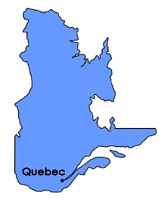
Reading Level
     edHelper's suggested reading level:   grades 3 to 5
     Flesch-Kincaid grade level:   3.47

Vocabulary
     challenging words:    Abitation, dowry, feudal, filles, heading, moat, palisade, province, treaty, drawbridge, settlement, cheap, plots, narrow, supplies, several
     content words:    Lawrence River, Roman Catholic Church, One Hundred Associates, New France, Hundred Associates


Print Champlain's Quebec
edHelper.com subscriber options:
     Print Champlain's Quebec  (font options, pick words for additional puzzles, and more)

     Quickly print reading comprehension

     Print a proofreading activity


Feedback on Champlain's Quebec
     Leave your feedback on Champlain's Quebec  (use this link if you found an error in the story)


Champlain's Quebec
By Mary Lynn Bushong
  

1     The first explorers from France discovered furs in the Americas. It was not long before furs became the most important part of trade.
 
2     France wanted the money from furs. She sent many explorers and traders to get as much fur as they could. One of those explorers was Samuel de Champlain.
 
3     In 1608, he was asked to help start a new settlement. This was also to be the first year round trading post.
 
4     This new settlement was built where the St. Lawrence River narrowed. In the native tongue the place was called Kebec for "narrow river."
 
5     Quebec had a good harbour for ships. It was also the perfect place for a town. There was good land for farming. There were trees for lumber.
 
6     The people built a place to live. It was one large building. There were places for the people to live. There was also room to store furs and food. It was called the "Abitation." A wooden palisade went around the building. A moat went around the fence. A drawbridge let people in and out.
 
7     The first winter, several people died. They needed more people to help the colony. It began to grow slowly. Soon they were able to grow more food, but it wasn't enough.
 
8     In 1627, some big changes were made. The Roman Catholic Church was given a large part of the good land. The church chose the people to control it. Those people broke the big lots into smaller ones. Then men who wanted to farm could have plots.
 
9     This was how land was divided in Europe. It was called the feudal system.

Paragraphs 10 to 17:
For the complete story with questions: click here for printable


Copyright © 2008 edHelper