edHelper.com
Animal Themes
Insects
Invertebrates


Cicadas


Cicadas
Reading Level
     edHelper's suggested reading level:   grades 4 to 7
     Flesch-Kincaid grade level:   7.7

Vocabulary
     challenging words:    lengthy, metamorphosis, opening, therefore, hence, species, darken, fully-grown, locust, molt, swarm, temperate, tropical, wherever, nymph, settled
     content words:    Southeast Asia, United States


Print Cicadas
edHelper.com subscriber options:
     Print Cicadas  (font options, pick words for additional puzzles, and more)

     Quickly print reading comprehension

     Print a proofreading activity


Feedback on Cicadas
     Leave your feedback on Cicadas  (use this link if you found an error in the story)


Other Languages
     Spanish: Las Cigarras


Cicadas   

1     If you live in tropical or temperate areas, such as Southeast Asia or the East and Midwest of the United States, you will know summer has arrived when you hear the loud buzzing sounds made by cicadas.
 
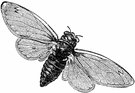
2     Cicadas are medium-sized insects, measuring up to 2.5 inches. They usually have brownish black or green-colored stout bodies and two pairs of clear wings marked with branching veins. Cicadas have a pair of short antennae and a pair of prominent compound eyes on their blunt heads. Male cicadas are devoted singers. Yet, they don't sing with their mouths. Instead, they sing with their bellies. Male cicadas have drum-like membranes on each side of their abdomens that can vibrate very quickly to make buzzing sounds. As they play their music, they hope to attract female cicadas. Unfortunately, by announcing their presence so loudly, audible more than a mile away, male cicadas inadvertently attract predators, such as cicada killer wasps, as well.
 
3     Cicadas are often nicknamed "locusts" or "harvest flies" in the United States, but they are neither locusts nor flies. True locusts that look like grasshoppers travel in such a large swarm that they can darken the sky. Locusts destroy crops wherever they fly. Cicadas are not as destructive as locusts. Nevertheless, they still cause some damage to orchards when they cut an opening on tree branches to drink sap or to deposit eggs. Hence, orchard farmers don't like cicadas very much.

Paragraphs 4 to 6:
For the complete story with questions: click here for printable


Copyright © 2008 edHelper