edHelper.com
Animal Themes
Invertebrates
Oceans


Corals


Corals
Reading Level
     edHelper's suggested reading level:   grades 4 to 8
     Flesch-Kincaid grade level:   8.79

Vocabulary
     challenging words:    anatomy, clone, cylindrical, delicacy, framework, internal, single-celled, sperm, starfish, generally, despite, opening, feathery, larva, lifetime, nutrition


Print Corals
edHelper.com subscriber options:
     Print Corals  (font options, pick words for additional puzzles, and more)

     Quickly print reading comprehension

     Print a proofreading activity


Feedback on Corals
     Leave your feedback on Corals  (use this link if you found an error in the story)


Corals   

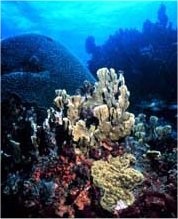
1     In the blue underwater world, there are many creatures that are not what they appear to be. Among them, corals are probably the best example.
 
2     Corals come in a variety of shapes, sizes, and colors. Some resemble trees with leafless branches. Some look like mushrooms. Some remind us of human brains. The list goes on and on. Regardless of what they appear to be, they are usually fixtures on rocks. Their lack of mobility is like vegetation on land -- plants grow, but they do not uproot themselves to be somewhere else. So, just as we are ready to classify corals as underwater plants, we realize that they are actually animals!
 
3     "Coral" can mean one of two things. The first is the living marine invertebrate itself that we also refer to as a coral polyp or a polyp. The second is the limestone skeleton some coral species have and leave behind when they die. For corals with such an internal structure, we call them "hard corals"; for those without, we call them "soft corals." The calcareous remains of hard corals become the framework of coral reefs.

Paragraphs 4 to 10:
For the complete story with questions: click here for printable


Copyright © 2008 edHelper