edHelper.com
Geography


Landforms


Landforms
Reading Level
     edHelper's suggested reading level:   grade 3
     Flesch-Kincaid grade level:   4.98

Vocabulary
     challenging words:    flatter, landform, landforms, rainfall, Rainforests, saltwater, savannahs, tends, vegetation, natural, deserts, grassland, planet, series, hawaii, however
     content words:    In North America, Rocky Mountains, Appalachian Mountains, Andes Mountains, South America, Mississippi River, United States, Nile River, Mediterranean Sea, Sahara Desert


Print Landforms
edHelper.com subscriber options:
     Print Landforms  (font options, pick words for additional puzzles, and more)

     Quickly print reading comprehension

     Print a proofreading activity


Feedback on Landforms
     Leave your feedback on Landforms  (use this link if you found an error in the story)


Landforms
By Trista L. Pollard
  

1     You have learned that our planet is covered with continents and oceans. Well, there are other landforms that are found on our planet. Landforms are natural features that are found on Earth. Some of these features are water and others are land surfaces.

 
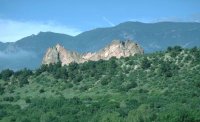
2     Let's start with some of the biggest on Earth. Mountains are high, rocky landforms that have steep sides. Some of our mountains are part of huge groups called mountain chains. Mountain chains are series of hills or mountains that stretch over large areas. In North America, there are the Rocky Mountains and the Appalachian Mountains. The Andes Mountains are found in South America. If you went to visit Switzerland in Europe, you would see part of the Alps mountain chain.
 
3     The tops of mountains are very far from the ground. That means the climate in the mountains is very different from the climate on flatter land. Climate is the temperature, wind, and precipitation of an area. Temperature is the degree of hotness or coolness of an area. Precipitation is what we see all of the time. It is the rain, sleet, and snow that fall from the sky. The climate in the mountains tends to be cooler. You may even see snow on the tops of mountains when there isn't snow on the flatter land that surrounds the mountain.

Paragraphs 4 to 9:
For the complete story with questions: click here for printable


Copyright © 2008 edHelper