edHelper.com
Solar System


Neptune


Neptune
Reading Level
     edHelper's suggested reading level:   grades 8 to 9
     Flesch-Kincaid grade level:   8.39

Vocabulary
     challenging words:    brightness, methane, mathematician, originate, mathematical, calculate, precise, composition, helium, discovery, calculation, core, hydrogen, spacecraft, measurement, orbit
     content words:    Neptune Math, In England, John Couch Adams, In France, Urbain Leverrier, Johann Galle, Heinrich D'Arrest, Neptune Chemistry, Since Neptune


Print Neptune
edHelper.com subscriber options:
     Print Neptune  (font options, pick words for additional puzzles, and more)

     Quickly print reading comprehension

     Print a proofreading activity


Feedback on Neptune
     Leave your feedback on Neptune  (use this link if you found an error in the story)


Neptune
By Sharon Fabian
  

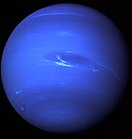
1     The story of Neptune's discovery is a story about Math and Chemistry. Neptune was discovered because of the predictions of two mathematicians. Later, Voyager 2 gave us some clues as to Neptune's chemical makeup. Scientists have put all of these mathematical and chemical clues together to learn as much as they can about planet Neptune.

 
2     
Neptune Math

     In the 1840's, astronomers were interested in the planet Uranus, the most recently discovered planet. Since it was so far away, one of the best ways they had to learn more details about Uranus was through math. Mathematicians were studying Uranus's orbit when they noticed something strange. Uranus didn't travel along its path at an even speed. It sped up sometimes, and sometimes it slowed down. What did this mean? What was causing Uranus to change its speed at certain times? The scientists had a theory. They thought the cause might be a pull from the gravity of another planet even farther out. In England, a mathematician named John Couch Adams worked on the problem. He was able to calculate Uranus's orbit and then predict where the gravitational pull should be coming from. In France another mathematician, Urbain Leverrier, studied the same problem and came up with a similar solution. Then two German astronomers, Johann Galle and Heinrich D'Arrest, began looking through their telescopes for the mystery planet. They used Adams's and Leverrier's calculations to tell them just where to look. This is how they discovered Neptune.
 
3     Mathematical calculations have also made it possible for scientists to discover Neptune's moons. Its largest moon, Triton, was discovered in 1846, the same year that Neptune was discovered. In 1949 a second moon, Nereid, was discovered. Then, in 1989, six more moons were discovered when the Voyager 2 spacecraft flew by Neptune. Only by precise mathematical calculation was this voyage even possible. Exact calculations of speed, time, distances, gravities, and orbits guided Voyager 2.

Paragraphs 4 to 6:
For the complete story with questions: click here for printable


Copyright © 2008 edHelper