
Worksheets and No Prep Teaching Resources
Reading Comprehension Worksheets
Earthquakes
Earthquakes
|
Worksheets and No Prep Teaching Resources Reading Comprehension Worksheets Earthquakes |
Earthquakes |
| edHelper's suggested reading level: | grades 5 to 7 | |
| Flesch-Kincaid grade level: | 7.82 |
|
Passing Plates II - Who's Fault?
By Trista L. Pollard |
|
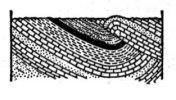 1 In Passing Plates I, we took a trip back through history to see where the plate tectonic theory was born. Let's journey deeper into the earth to learn about these plates. Most of the plate "action" occurs within the lithosphere, which includes the crust and upper mantle. The crust is the solid outermost layer of the earth, and the mantle is the layer under the crust where the plate movement occurs. All of this makes the lithosphere one restless place. The places where the plates meet in the lithosphere are called plate boundaries. Earthquakes usually occur in plate boundaries. There are three types of plate boundaries: divergent, convergent, and transform.
 |
Create Weekly Reading Books
Prepare for an entire week at once! |
| Leave your feedback on Passing Plates II - Who's Fault? (use this link if you found an error in the story) |
|
Earthquakes
|
 |
Science
|