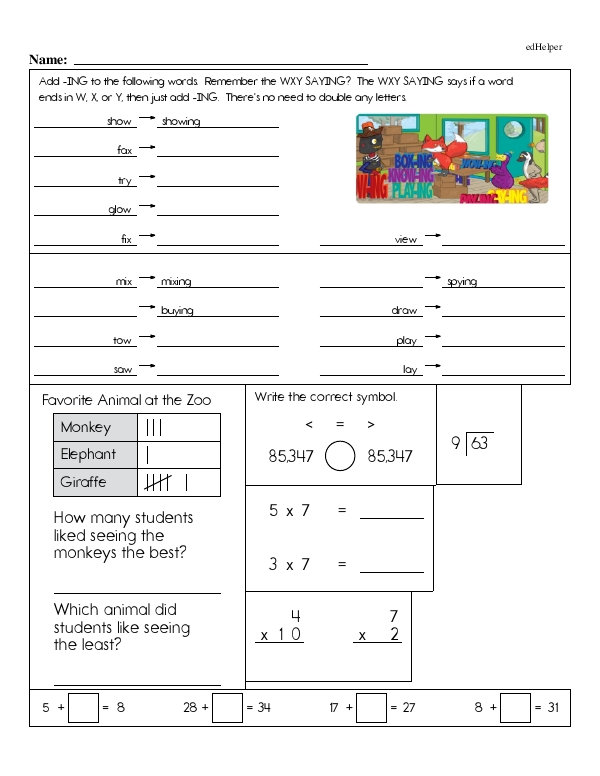
The worksheet titled "Add -ING to Words That End in W, X, and Y" gives students practice with the WXY Saying. The directions remind students that words that end in W, X, or Y can end in ING without adding any double letters.
The rest of the page lists a blank on the left of an arrow and a blank on the right that the arrow points to. Most of the time, the left-hand blank is filled in with a word, and students rewrite the word on the right with ING. For example, the word on the worksheet might be "thaw," and students write "thawing" in the blank on the right. Sometimes, the blank is on the left, and students have to figure out the base word. For example, the word on the right might be "snowing," and students have to write "snow" in the left blank.
Each page includes 14 sets of blanks with a divider in the middle, giving students the opportunity to complete worksheets in two sections.
Learning how to add ING to words is an important skill as students develop the concept of base words and other versions of those words that can be created depending on the prefixes and suffixes they add.
It's a good idea to start with easier skills before moving on to more difficult skills. For example, when practicing adding ING, students can start with words that end in W, X, and Y because they only have to add ING to make the new word. As they get better at this skill, you can ask them to add ING to words that end with letters that need to be doubled first, like turning "run" into "running." As students build mastery, you could combine these skills so students have to figure out on their own how to add ING and spell the word correctly.
Add -ING to Words That End in W, X, and Y
Add -ING to Words That End in W, X, and Y
GRADES: