

"Add to Find the Solution: Shading and Crossing Out Boxes Puzzles" is a fun worksheet where students get to practice their problem-solving and addition skills.
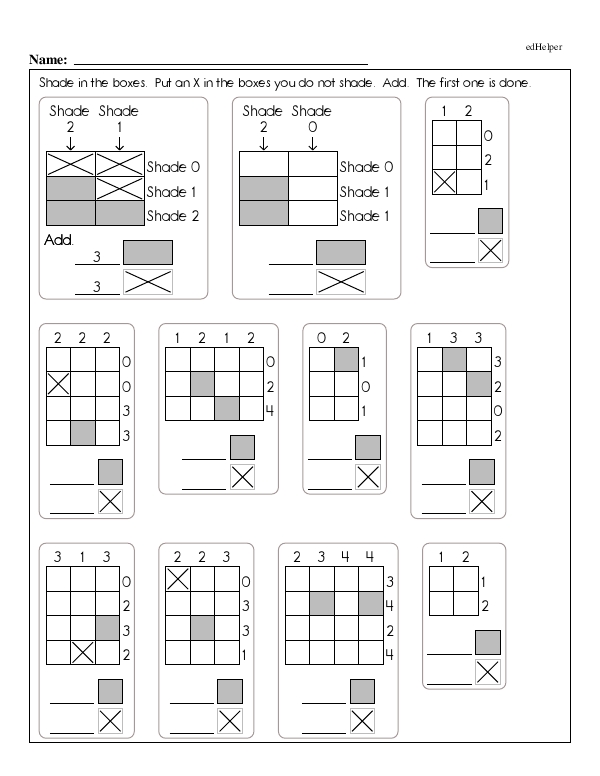
Each worksheet page displays multiple grids of boxes with multiple rows and columns. Lower grade levels have fewer rows and columns, while higher grade levels have more. Numbers on the outside of the grid give students clues as to how many boxes are shaded in each column and row. They must follow the clues to shade in the correct number of boxes and draw Xs in boxes that aren't shaded. Then, they add up the number of shaded and crossed-out boxes and write their answers below.
Each set of puzzles features one completed puzzle, as well as directions that tell students what to do. The first few puzzles also label the numbers in each row and column according to how many need to be shaded, along with arrows, so students can see how to narrow down which boxes need to be shaded and which ones need to be crossed out.
Students should get plenty of practice adding numbers, but combining addition with problem-solving helps students learn how to follow directions, pay attention to details, and think about addition in new ways.
Puzzles and brainteasers can be used to help students think differently about addition. Students can complete addition crosswords or sum Sudoku, where different columns and rows have to add up to specific numbers. Students can work out the value of different images in a picture addition problem or complete Tarsia puzzles. When students become proficient at a certain type of puzzle, you can ask them to create their own and exchange it with a classmate.
Add to Find the Solution: Shading and Crossing Out Boxes Puzzles
Add to Find the Solution: Shading and Crossing Out Boxes Puzzles
GRADES:



Additional Educational Resources:
Using Bar Models: Addition and Subtraction Large Workbook - (Grade 2)
Addition Up to 10,000 Large Workbook - (Grade 3)
Quick Assessment - Digits in Their Places: Mastering Whole Numbers and Place Value
Quick Assessment - Easy Lightning-Fast Subtraction Problems