

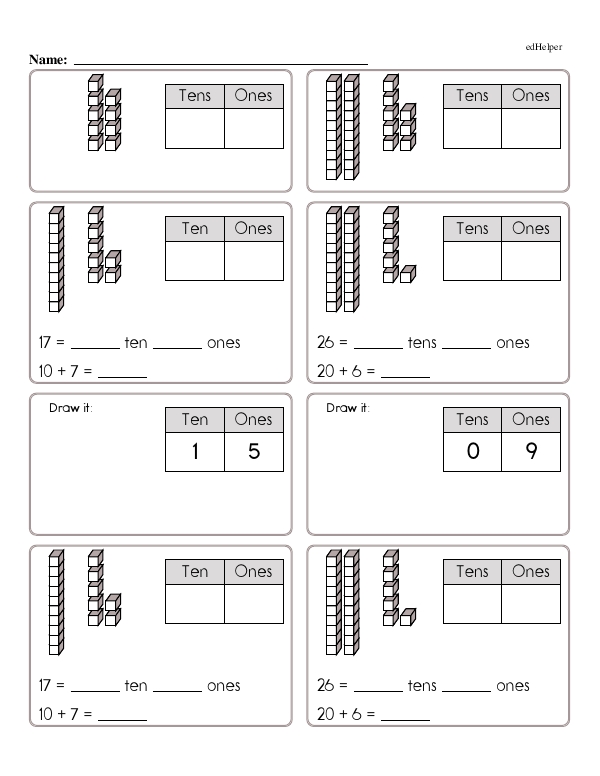
The worksheet titled "Breaking Numbers Into Tens and Ones With Base Ten Blocks and Addition" is designed to help young students visualize two-digit numbers as two different numbers added together.
Each page contains eight problems that are separated by rectangles. Each problem displays a number as a series of base ten blocks. Students count the tens and write how many there are. Then, they count the ones and write how many there are.
Some problems don't contain any additional work. Other problems invite students to think more deeply by writing out a number as tens and ones. For example, the prompt might read, "39=___tens ___ ones." Then, it breaks it down into an addition problem like "10+9=___." Students fill in the blanks.
Giving students the opportunity to visualize numbers in different ways helps them become more fluent mathematicians. It gives them confidence and provides them with the ability to think about numbers and problems in new ways, which can help them tackle more difficult math as they grow older.
Base ten blocks are a good way to start because they give students practice breaking numbers down into place values. They can count the number of tens and the number of ones, then combine them to get the answer.
Displaying numbers this way also gives them the ability to see that a two-digit number is just two different numbers added together. As students become more proficient, they can count hundreds and thousands of blocks.
This strategy also gets students used to counting by tens or hundreds. More difficult problems could ask students how many groups of twos or fives are in a number to give them even more practice breaking larger numbers down into groups.
Breaking Numbers Into Tens and Ones With Base Ten Blocks and Addition
Breaking Numbers Into Tens and Ones With Base Ten Blocks and Addition
GRADES:

Additional Educational Resources:
Addition and Subtraction to 40 Large Workbook - (Grade 1)
Addition up to 1,000 Large Workbook - (Grade 2)
Quick Assessment - Exploring Place Value: Numbers to 1,000