

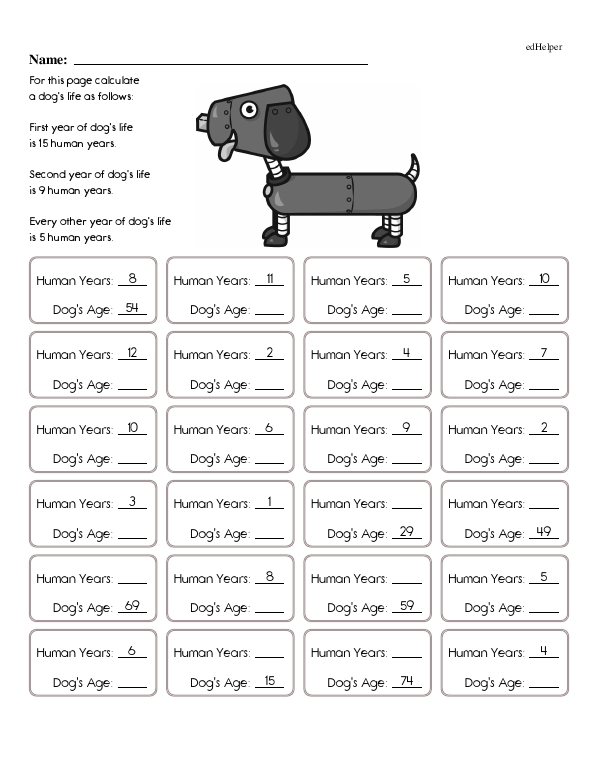
The worksheet called "Calculate the Age of a Dog: Using Multi-Step Arithmetic and Conditional Logic" is a fun and engaging way for students to follow math rules to figure out the age of a dog. The directions on the top of the page tell students that the first year of a dog's life equals 15 human years, the second year of a dog's life equals 9 human years, and every other year of a dog's life equals 5 human years. Based on those rules, students look at the human years listed and figure out how old the dog is.
There are 24 boxes on each page that list human years and the dog's age with blanks so students can write the number. The first box on each page shows both the human years and the dog's age as an example. Some boxes also ask students to figure out the human years based on the dog's age.
Math requires precision and the ability to follow rules. It can be helpful to challenge students' thinking by providing them with math activities that require them to follow certain steps or math rules as part of the same problem.
For example, they could find the age of a dog by following different rules for how a dog ages. So, the first year would equal 15 human years, the second year would equal 9 human years, and every other year would equal 5 human years.
Other types of similar activities include an amusement park that charges different prices depending on the day or the time, like charging more on the weekends or charging less after 6 p.m. Students could figure out how much a family of four would pay to go on a Saturday, what they would pay on Monday morning, and what they would pay on Thursday evening.
Another activity might be charging a specific price for a piece of pizza, but it costs less if you also buy a drink. You could ask students how much money the restaurant would make if a certain number of people bought just pizza or bought pizza and a drink.
Calculate the Age of a Dog: Using Multi-Step Arithmetic and Conditional Logic
Calculate the Age of a Dog: Using Multi-Step Arithmetic and Conditional Logic
GRADES:

Additional Educational Resources:
Whole Number Multiplication and Division Large Workbook - (Grade 5)
Algebra Large Workbook - (Grade 5)
Quick Assessment - Number Sense: Estimation, Factors & Multiples