

These worksheet pages give students two ways to practice comparing single- and double-digit numbers, with low 100s making an appearance on a few pages.
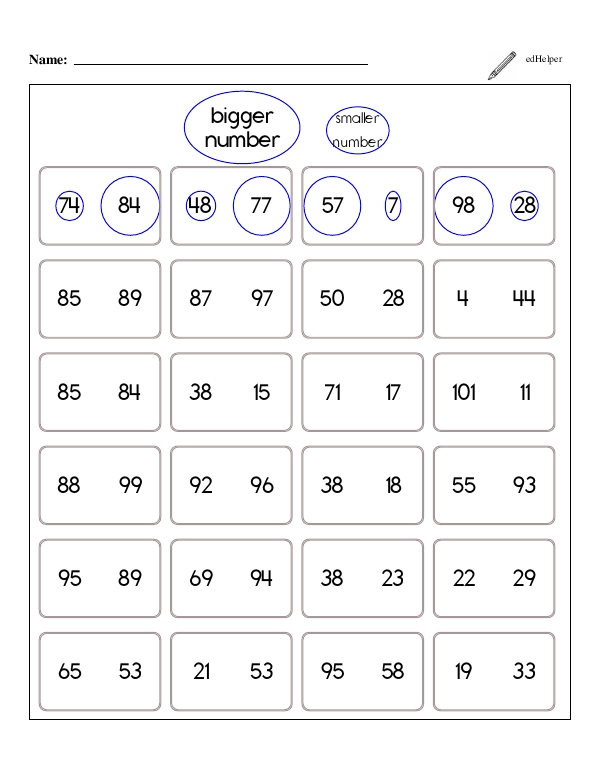
The first page asks students to compare two numbers. They draw a large circle around the biggest number and a small circle around the smallest number. The first few are completed as an example.
The second page asks students to compare two numbers with greater than and less than symbols. The activity is scaffolded for students by having them circle the numbers as they did on the first page and use the size of the circles to create a greater than or less than symbol. Then, they write the symbol in the box. Examples progressively release control to the students, with the ultimate goal of having them circle the numbers and draw the greater than or less than symbol themselves.
Comparing numbers supports the development of number sense. This enables students to build a relational view of numbers. It can also help with some math tasks, like subtraction and division, when the placement of the bigger and smaller numbers is important.
Comparing numbers can be as easy as circling the bigger number in a pair. You can have students use large and small circles to scaffold understanding of the greater than and less than symbols.
Students who need a greater challenge could order a string of numbers from biggest to smallest or smallest to biggest. Have students compare large numbers in the thousands or ten thousands, decimals or fractions, and negative numbers, depending on their current learning level.
Circling Bigger and Smaller Numbers, and Greater Than/Less Than Practice
Additional Educational Resources:
Numbers to 40 Large Workbook - (Grade 1)
Numbers to 1,000 Large Workbook - (Grade 2)
Quick Assessment - Exploring Place Value: Numbers to 1,000
Circling Bigger and Smaller Numbers, and Greater Than/Less Than Practice
GRADES:

Additional Educational Resources:
Numbers to 40 Large Workbook - (Grade 1)
Numbers to 1,000 Large Workbook - (Grade 2)
Quick Assessment - Exploring Place Value: Numbers to 1,000