

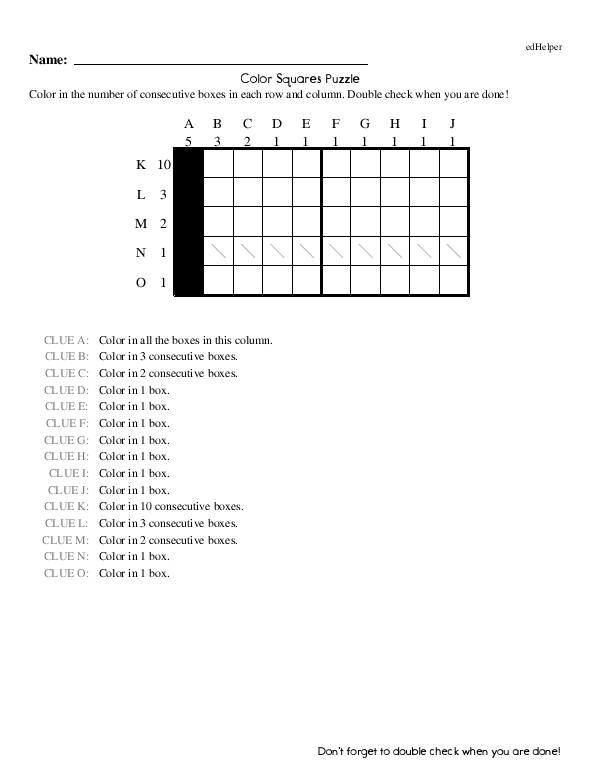
The worksheet titled "Color Squares Puzzle: Follow the Clues to Color the Correct Squares" features a grid of squares at the top of the page, along with directions that state, "Color in the number of consecutive boxes in each row and column. Double-check when you are done!" Below the grid is a list of clues that are associated with each column and row. Students must color the boxes according to each clue. In some cases, they may have to skip a clue and come back to it according to the numbers that are associated with each column and row in the grid.
For example, Clue A may instruct students to color in 1 box, but they may not know which box to color in. However, they might see that Clue K requires students to color in 10 consecutive boxes. With only 10 boxes in that row, the entire row is colored, which means the box in that row that corresponds with Clue A is colored.
Each page contains a single puzzle. Grids feature more columns and rows as the difficulty increases. Some clues also get trickier at higher grade levels, requiring students to practice age-appropriate problem-solving skills.
There is a place in the classroom for puzzles and brainteasers because they encourage problem-solving and critical thinking skills, which can help students in any subject, including math and reading. You can include puzzles and brainteasers in any subject when you have extra time, or you could carve out some time each day to tackle a puzzle. They are great for a soft start, or they can be used to wrap up at the end of a subject.
Introduce puzzles and brainteasers students might already be familiar with, like Sudoku puzzles. You should also include puzzles, like Color Square Puzzles, which students may not be familiar with, as they further encourage critical thinking and problem-solving skills. If puzzles are difficult, consider allowing students to work together. If you want to work on building confidence, consider lower-level puzzles that students can solve easily so they're encouraged to keep trying when faced with more difficult problems.
Color Squares Puzzle: Follow the Directions to Color the Correct Squares
Color Squares Puzzle: Follow the Directions to Color the Correct Squares
GRADES:
Additional Educational Resources:
Lines and Surfaces Large Workbook - (Grade 2)
Shapes and Patterns Large Workbook - (Grade 2)
Quick Assessment - Geometry Challenge - Shapes, Flips, and Turns