

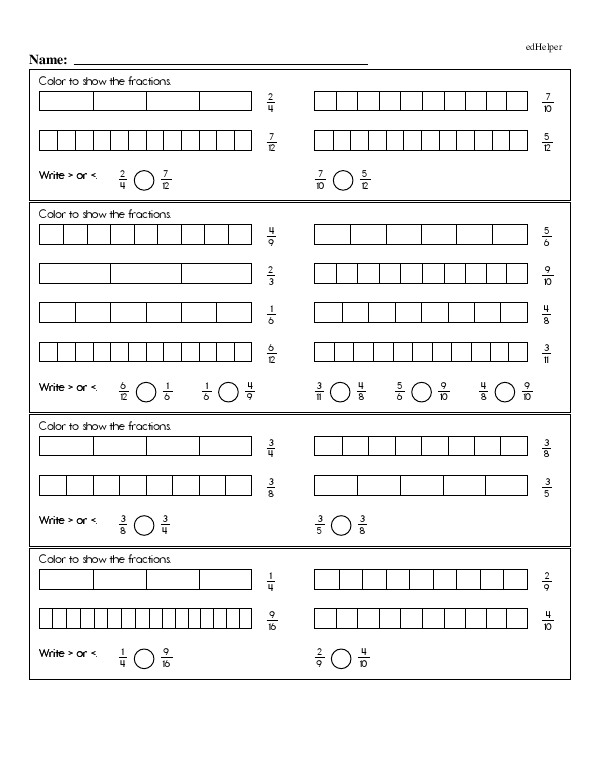
The worksheet "Coloring a Model and Comparing Fractions" features sections that ask students to complete two different fraction activities. The first asks students to color in different fractions. Each fraction is written with an empty fraction bar that is divided into the appropriate number of sections as represented by the denominator. Students color in the number in the numerator.
Underneath, students compare the two fractions they colored with a greater than, less than, or equal to symbol. For example, they might color the fractions 3/8 and 1/2. Once colored in, they can see which one is bigger and which one is smaller, filling in the correct symbol.
Each section features a different number of fractions. Two, three, and four fractions can be colored and compared at the same time.
Being able to compare fractions is an important skill for students to learn. Not only does it build understanding, but it also helps prepare students for creating equivalent fractions so they can be compared more easily.
Finding ways to let young students compare fractions visually is a good first step. Allow them to color in fraction bars for two different fractions before writing which one is larger and which one is smaller. Then, have them color multiple fraction bars before putting each fraction in order from smallest to largest.
You can also ask students to see if the sections in the fractions they're comparing match up. For example, if they color in 4ths and 12ths, they can see that each 4th can be divided into three sections. They can see that 2/4 is greater than 2/12, but they can also see that 6/12 would be equal to 2/4.
Coloring a Model and Comparing Fractions
Additional Educational Resources:
Using Bar Models: Addition and Subtraction Large Workbook - (Grade 3)
Using Bar Models: Addition and Subtraction Large Workbook - (Grade 2)
Quick Assessment - An Introduction to Fractions: Visualizing Fractions
Quick Assessment - Geometry Challenge - Shapes, Flips, and Turns
Coloring a Model and Comparing Fractions
GRADES:
Additional Educational Resources:
Using Bar Models: Addition and Subtraction Large Workbook - (Grade 3)
Using Bar Models: Addition and Subtraction Large Workbook - (Grade 2)
Quick Assessment - An Introduction to Fractions: Visualizing Fractions
Quick Assessment - Geometry Challenge - Shapes, Flips, and Turns