

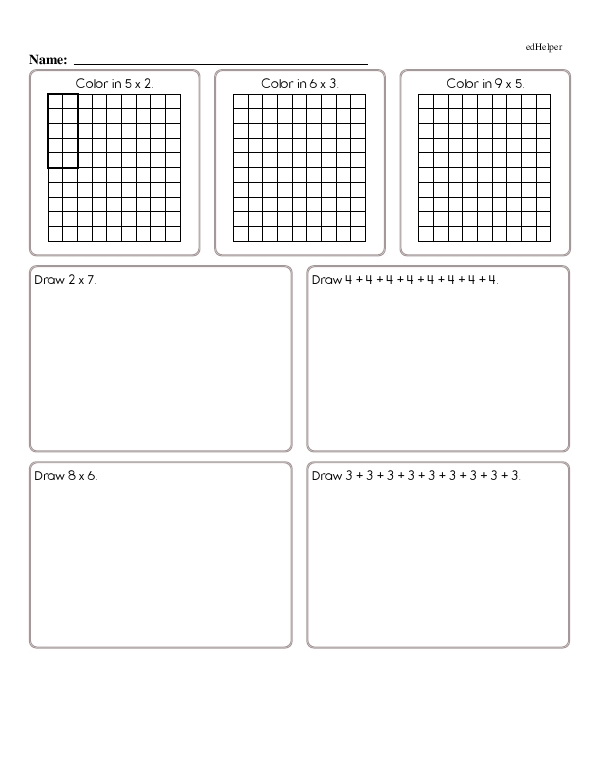
The worksheet titled "Coloring in and Drawing Multiplication With Arrays" begins by displaying three arrays of smaller cubes in a larger square. Each one directs students to color in a specific area. For example, the directions might say, "Color in 4x3." The first problem contains an outline that students can color in, but the next two do not, so students have to count out the rows and columns on their own.
Below are four problems that ask students to draw their own arrays. Some arrays reflect a multiplication problem, like one that says "Draw 5x8." Others display a repeated addition problem like "Draw 7+7+7+7." Students have to draw what it would look like as an array.
Each question is included in a larger square with plenty of space so students can draw out their array.
Being able to visualize multiplication problems helps students build a firm foundation so they can tackle more difficult problems in the future.
First, you can help students see how multiplication works by having them color in an array on a grid. For example, you might display a grid that's 10x10 squares and ask them to color in 6x4. This exercise is especially helpful for students who are still counting one at a time, as they can see exactly how they end up with the final answer.
Students can also draw their own arrays. They can draw grid-style arrays, but they can also have more fun by drawing colored dots or even pictures. This can be a great way to tie in word problems. For example, students might draw an array of cats for a word problem like "If there are 7 cats in the shelter and each one needs two bowls for food and water, how many bowls do you need altogether?"
Tying in repeated addition is also a great way to get students to visualize multiplication problems. You can ask them to draw 5+5+5+5+5+5, but don't tell them how to do it, so you can see how they visualize the problem.
Coloring in and Drawing Multiplication With Arrays
Coloring in and Drawing Multiplication With Arrays
GRADES:

Additional Educational Resources:
Using a Bar Model: Multiplication and Division Large Workbook - (Grade 3)
Multiplication and Division Large Workbook - (Grade 2)
Quick Assessment - Multiply 1, 2, or 10: Simple Steps to Multiplication Success