

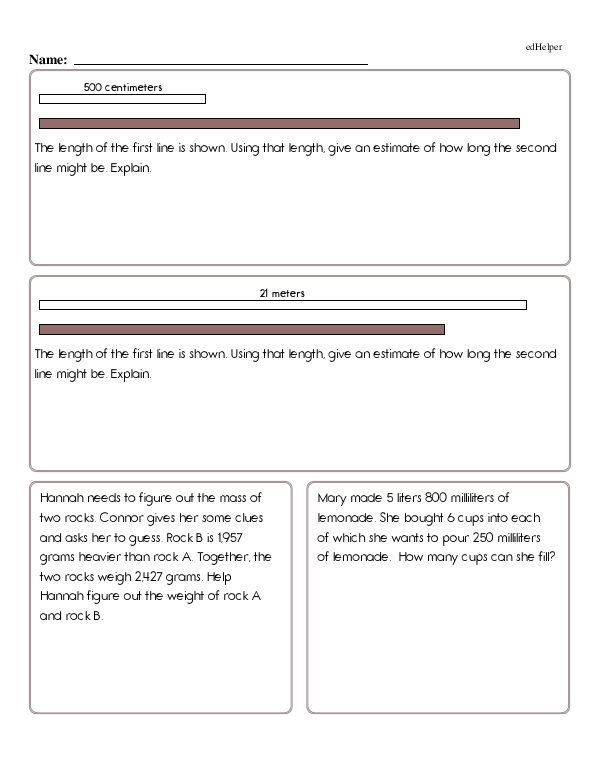
The worksheet titled "Comparing and Estimating Lengths With Volume and Weight Word Problems" starts with two measurement problems. Each one shows two rectangles of different lengths. One of the rectangles is labeled in meters, centimeters, or both. Students must estimate how long the other rectangle is and explain their answer.
Below are two measurement word problems. One deals with grams. Students have to use the clues in the word problem to figure out the weight of two rocks. The other problem deals with liters and milliliters. Students have to figure out how many cups they can fill with lemonade according to the clues they are given in the problem.
All four problems on each page are contained within a square-shaped boundary. Each boundary includes extra space where students can explain their thinking.
Learning how to measure length, weight, and volume is an important real-world skill. It is especially helpful to invite students to explore the metric system with problems they might encounter in real life.
For example, students can be asked to estimate the length of one object when they are given the length of another object. You can give students real objects to compare, but this activity also lends itself well to cutting. Students can cut out the rectangle with a known length and compare it to other rectangles to estimate how long they are. They could even practice converting measurements from the US Imperial system to the metric system.
Word problems can help students explore mass, like figuring out how many grams two objects are by following the clues. Students can also see how many cups they can fill with a certain amount of lemonade when they know how many milliliters each cup holds. They could even double-check their answer by pouring lemonade for the class.
Comparing and Estimating Lengths With Volume and Weight Word Problems
Comparing and Estimating Lengths With Volume and Weight Word Problems
GRADES:
Additional Educational Resources:
Squares and Rectangles Large Workbook - (Grade 4)
Real-World Problems: Measurement Large Workbook - (Grade 3)
Quick Assessment - Number Sense: Estimation, Factors & Multiples