

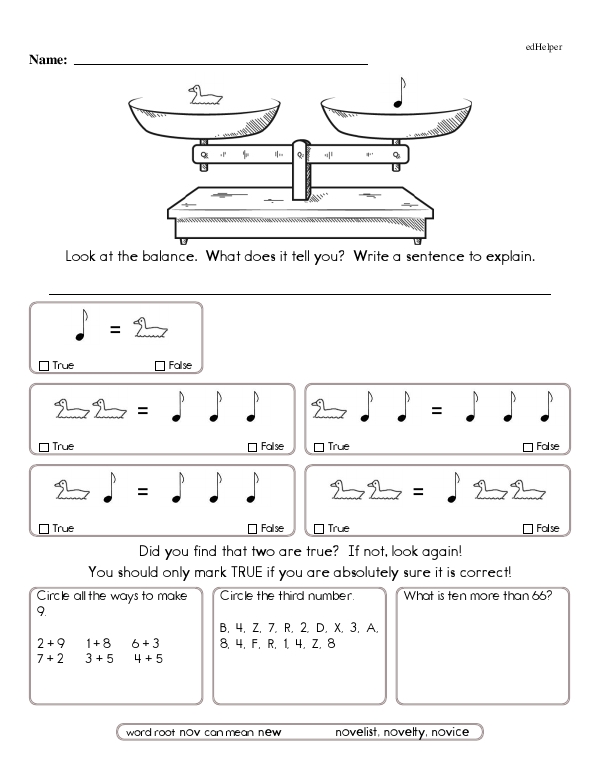
The worksheet titled "Comparing the Weights of Two Pictures With True-False Statements" features a scale at the top. Each side of the scale features one picture, with both pictures balancing each other perfectly. Picture equations are listed below the scale, with the option for students to mark true or false depending on whether the equation is correct or incorrect.
For example, one side of the scale might display a duck while the other displays a leaf. An equation might show three ducks equaling one leaf and two ducks. Students have to mark whether that equation is true or false.
Upper grade levels introduce numbers with pictures. For example, one side of the scale features a raindrop that equals 3 and a flower that equals 5. Students have to figure out how much the goose on the other side of the scale equals. Additional equations are included where students can mentally replace the pictures with numbers, like whether or not two raindrops and a flower equal two geese.
It's important to note that the balanced pictures are considered equal for the purposes of the worksheet. For example, an image of a pumpkin and an umbrella are shown having the same weight on the scale. They are considered equal, even though, in real life, a pumpkin would be heavier than an umbrella.
Visualizing equal groups is a great way to solidify multiplication concepts. This can be done with numbers, but you can also use pictures, which can build the foundation for algebraic concepts.
For example, students can easily see that 3=3 or 2+2+2=6. You can make it a little trickier by replacing numbers with images. If the picture of a hat and a flower is considered equal, students can use their critical thinking skills to figure out whether two hats equal a hat and a flower or whether four hats equal four flowers.
You can add an additional layer of difficulty with older students by assigning numbers to different pictures and displaying more than one picture on a scale. So, the bowl on one side of a scale might equal 9. The other side of the scale features a hand that equals 1 and a police hat. Students have to figure out how much the police hat weighs.
Once they get used to determining whether certain combinations of images equal others, they can create their own. They could even present their problem to a classmate while working in pairs.
Comparing the Weights of Two Pictures With True-False Statements
Additional Educational Resources:
Algebra Large Workbook - (Grade 5)
Using Bar Models: Multiplication and Division Large Workbook - (Grade 2)
Quick Assessment - Introduction to Multiplication: The Repeated Addition Adventure Book
Quick Assessment - Algebra Foundations - Variables in Action: Building and Solving One-Step Equations
Comparing the Weights of Two Pictures With True-False Statements
GRADES:

Additional Educational Resources:
Algebra Large Workbook - (Grade 5)
Using Bar Models: Multiplication and Division Large Workbook - (Grade 2)
Quick Assessment - Introduction to Multiplication: The Repeated Addition Adventure Book
Quick Assessment - Algebra Foundations - Variables in Action: Building and Solving One-Step Equations