

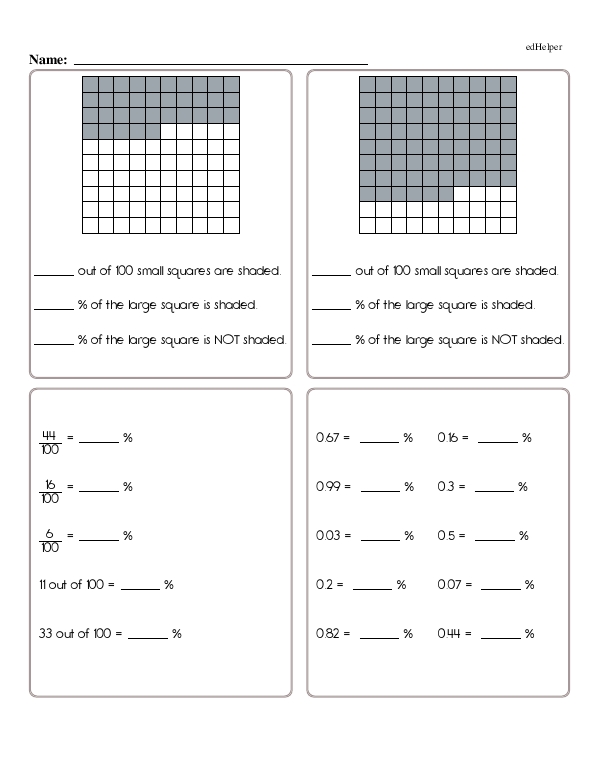
The worksheet "Converting Percents, Decimals, and Fractions With Shaded 100 Blocks" starts with two flat 100 blocks. Each one has a different number of shaded squares. Students write how many are shaded out of 100. Then they write the percentage of the block that is shaded and the percentage of the block that is NOT shaded.
Two more sets of problems are included at the bottom of the worksheet. One set asks students to convert fractions to percents by showing fractions, like 26/100, as well as statements, like 18 out of 100. The second set of problems asks students to convert decimals into percents. There are 10 of these for students to solve in that section.
Learning concepts like percents, decimals, and fractions together helps students build connections between concepts. This allows them to understand each one more deeply, and it also gives them multiple ways to approach future problems.
Visuals are always a good place to start. Shade squares in a 100 block and ask students to write the percentage of the squares that are shaded. They could also write the corresponding fraction and reduce it to lowest terms, if it's possible.
Students can draw their own pictures to help them figure out a problem. For example, with a fraction like 18/100, they could shade in 18 squares in a 100 block to find the percent. For an extra challenge, students can use greatest common factors to make a fraction larger to find a percentage, like expanding 1/4 to 25/100 before writing the percentage.
Students can also practice converting decimals to percentages, as it's a great way to solidify their understanding of place value. For example, 0.72 equals 72% because the tenths place represents 7/10, or 70 out of 100, while the hundredths place represents 2/100. Trickier decimals can include missing digits, like 0.9, or more zeros, like 0.02.
Converting Percents, Decimals, and Fractions With Shaded 100 Blocks
Converting Percents, Decimals, and Fractions With Shaded 100 Blocks
GRADES:
Additional Educational Resources:
Fractions and Decimals Large Workbook - (Grade 6)
Decimals Large Workbook - (Grade 5)
Quick Assessment - Fraction Fluency: Adding, Subtracting, and Converting Mixed Numbers
Quick Assessment - Decimals and Fractions: The Fraction-Decimal Connection