

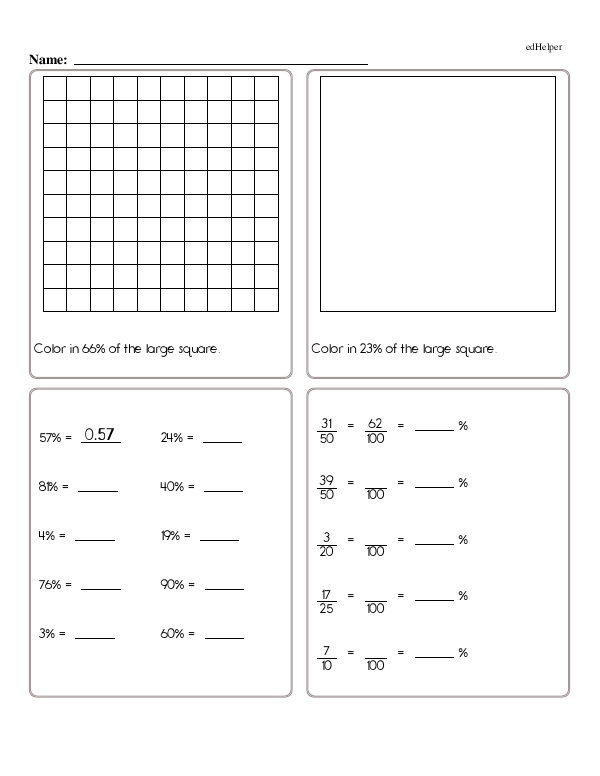
The worksheet titled "Converting Percents to Decimals, Fractions to Percents, and Shading 100 Blocks" has four distinct sections that tackle different ways for students to convert percents, decimals, and fractions.
The first section contains a blank 100 block. The instructions tell students what percentage of the large square they should color in. The second section is similar, but instead of giving students a blank 100 block, the block is empty. Students have to figure out how to divide the large square into smaller sections before shading in the percentage given.
The third section contains 10 different percentages. Students fill in the blank with the corresponding decimal.
The fourth and final section displays a fraction that needs to be expanded in order for students to write the percentage. The first one is given as an example, like 13/50 = 26/100. The rest require students to fill in the numerator, like 33/50 = ___/100, before writing the corresponding percent.
Having students learn how to convert fractions to percents, percents to fractions, and percents to decimals helps them learn how different ways to display numerical information can mean the same thing. This helps students create a deeper understanding of mathematical concepts, and it also gives them practice approaching problems from different angles, which can help them problem-solve in the future.
Start by asking students to shade in a picture that represents a certain percentage. They can shade the squares in a 100 block, or you can give them a blank square, and they have to draw and shade in the correct representation of a percentage.
You could also incorporate bars, especially if you want students to expand fractions. For example, a bar with 9 squares shaded out of 10 could be displayed. Students could find the corresponding percent by expanding the fraction to 90/100 first.
Tackling place value with decimals can help students understand percents better. For example, percentages are shown as decimals because they are a fraction of one whole. Learning about the fractions associated with the tenths and hundredths places can help them understand percentages better, too.
Converting Percents to Decimals, Fractions to Percents, and Shading 100 Blocks
Converting Percents to Decimals, Fractions to Percents, and Shading 100 Blocks
GRADES:
Additional Educational Resources:
Percents Large Workbook - (Grade 6)
Percent Large Workbook - (Grade 5)
Quick Assessment - From Decimals to Fractions: A Conversion Challenge
Quick Assessment - Fraction Fluency: Multiply and Divide Fractions & Mixed Numbers