

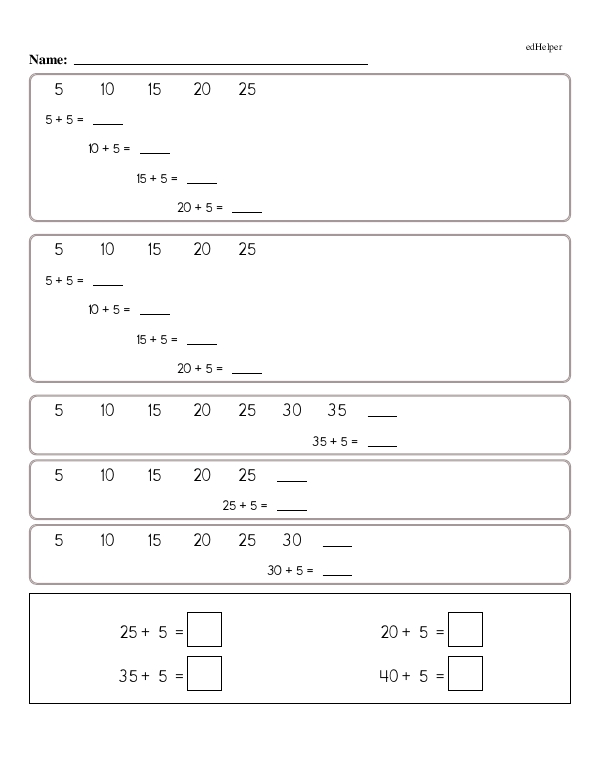
Students practice counting on and see the principles of skip counting in action on these worksheet pages. Each page features six different sections. The first two sections feature a line of numbers with addition problems that go with the numbers above. Students answer each problem and see how each answer becomes the next number in the series. For example, the section might list the numbers 2, 4, 6, 8 with 2 + 2 = ___, 4 + 2 = ___, and 6 + 2 = ___.
The next three sections list the same pattern, but the last number in the series is blank. The addition problem that corresponds to the blank number is listed below. For example, the series might include 3, 6, 9, 12, 15, 18, 21, 24, ___. The addition problem is 24 + 3 = ___. Students fill in the answer and the blank in the line of numbers.
The last section reviews addition problems that correspond to the problems the students were answering above. For example, on a page that invites students to count by twos, math problems at the bottom might include 16 + 2, 8 + 2, and 10 + 2. Students fill in the blank boxes with the answers.
Skip counting and counting on can help students discover patterns and begin to understand the mechanisms behind multiplication. Scaffolding activities can help students see how they're related.
Start by having students write a list of numbers that follow a specific pattern, like counting by twos or threes. Students who are just beginning to learn can fill in the blanks in a list of numbers, while more experienced students can list tricky patterns, like counting by sevens.
Introduce addition when they become good at skip counting. For example, you can show counting by fives with the addition problems 5 + 5, 10 + 5, and 15 + 5. Students can see that the answers correspond to the numbers in the pattern. They can use this method to see what numbers come next. For example, you could ask what number comes after 145. They could write the addition problem 145 + 5 to get the answer.
Counting On and Skip Counting With Addition
Additional Educational Resources:
Mental Math Strategies Large Workbook - (Grade 1)
Making Groups (Multiplication and Division Ideas) Large Workbook - (Grade 1)
Counting On and Skip Counting With Addition
GRADES:

Additional Educational Resources:
Mental Math Strategies Large Workbook - (Grade 1)
Making Groups (Multiplication and Division Ideas) Large Workbook - (Grade 1)