

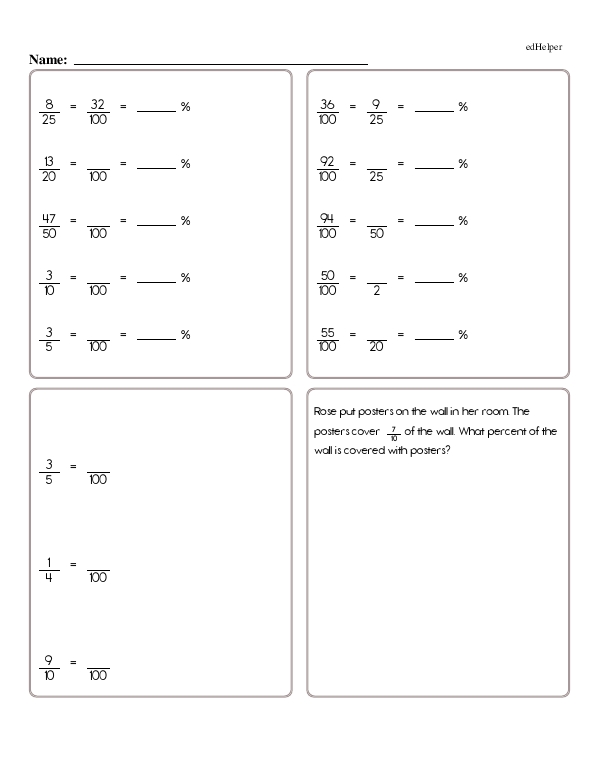
"Creating Equivalent Fractions and Converting to Percentages" is a worksheet that provides students with practice converting fractions with the purpose of turning them into percentages.
Each worksheet starts with a section that displays a fraction. Students must expand the fraction with a denominator of 100 so they can find the percentage. For example, the fraction might be 2/5. The next fraction has a blank numerator and a denominator of 100. Students fill in the missing numerator, in this case with the number 40, and then fill in the percentage as 40%.
The next section works in reverse. Students are given a fraction with a denominator of 100. They have to reduce it before writing the percentage. For example, the fraction 94/100 = ___/50. Students fill in the numerator, which would be 47 in this case, and then write 94% on the line.
The third section is similar. It provides students with a fraction that they expand to a fraction with 100 as the denominator, but students do not have to write the equivalent percentage.
The final box contains a word problem about a person who puts posters on their wall. Students have to figure out what percentage of their wall is covered based on the fraction that is given.
It's helpful for students to learn how to expand fractions when learning percentages. That enables them to take a fraction, like 9/20, and convert it to an amount out of 100, which gives them the equivalent percentage answer.
Students can get even more practice by doing the opposite. Have them start with a fraction out of 100 and ask them to reduce it. You could also give them a percentage, ask them to write the equivalent fraction, and then ask them to reduce it to the lowest terms.
Word problems can be an effective way for students to learn how to convert fractions to percentages. Whether it's figuring out what fraction of a lawn is covered in flowers when given the percentage or what percentage of a cake still needs to be frosted when given the fraction, answering questions like these can help students see how fractions and percentages are relevant in real life.
Creating Equivalent Fractions and Converting to Percentages
Creating Equivalent Fractions and Converting to Percentages
GRADES:
Additional Educational Resources:
Fractions and Decimals Large Workbook - (Grade 6)
Percents Large Workbook - (Grade 6)
Quick Assessment - The Decimal Toolbox: Adding and Subtracting Money and Decimals
Quick Assessment - Easy Fraction Frenzy Introduction: Coloring, Comparing, and Calculating