

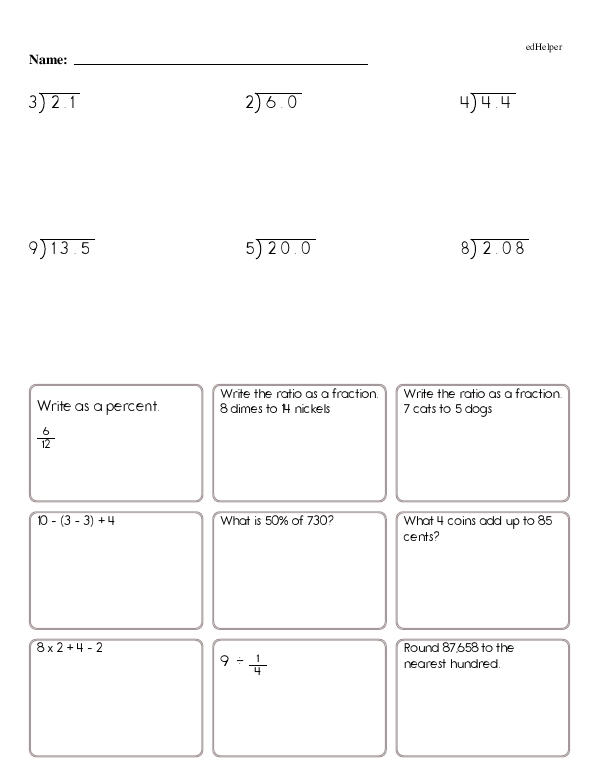
"Dividing Decimals Practice: Whole Divisors and Decimal Dividends" is a worksheet that contains nine division problems on every page. Each one features a single, whole-digit divisor and a decimal dividend. Each dividend has between one and three digits that can fall on either side of the decimal. A few example problems are 1.96 ÷ 7, 0.42 ÷ 6, and 26.1 ÷ 9. In some cases, the decimal isn't found in the problem, but the answer contains a decimal, like the problem 7 ÷ 4.
Problems are displayed with a division bracket and plenty of room for students to write the answers and work out the problem. In some cases, the dividend displays a whole number, like the problem above, but sometimes it is displayed as a decimal, like 2.0 ÷ 8, to help students associate whole numbers with their equivalent decimal.
When students learn how to divide decimals, they strengthen their number sense, prepare for higher-level mathematics, and learn real-world skills that they can apply to tasks like splitting a bill, comparing prices, or converting measurements.
Once they learn how to divide decimals, the best thing is to provide students with plenty of practice. Start with small decimal dividends, like 0.42, 3.6, and 12.6. Have them work with whole-digit divisors to keep things simple, but also consider giving them problems where dividing whole numbers turns into a decimal answer, like 2.0 ÷ 8, to further expand their thinking.
Students can do problems as homework or classwork, but they can also do worksheets with a partner to build confidence.
Dividing Decimals Practice: Whole Divisors and Decimal Dividends
Dividing Decimals Practice: Whole Divisors and Decimal Dividends
GRADES:
Additional Educational Resources:
Equations and Inequalities Large Workbook - (Grade 6)
Fractions and Decimals Large Workbook - (Grade 6)
Quick Assessment - Decimals and Fractions: The Fraction-Decimal Connection
Quick Assessment - Mastering Percent Calculations: Real-World Percents