

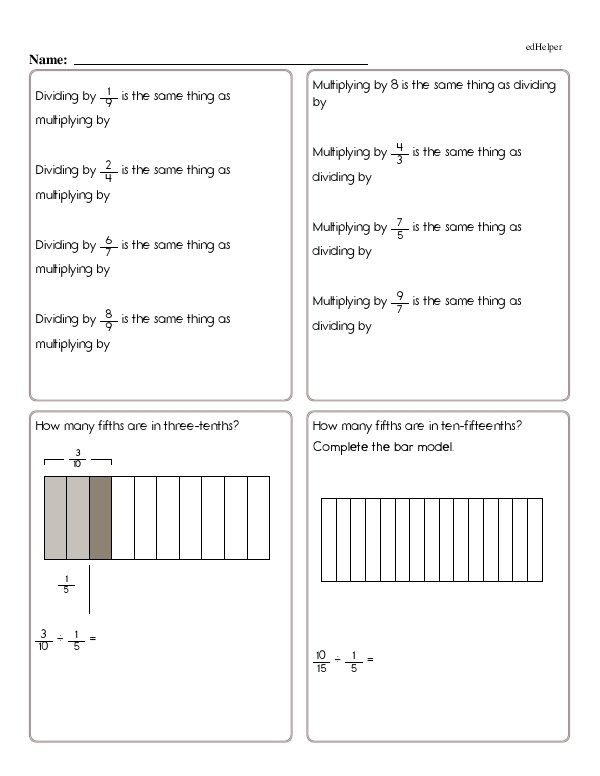
"Dividing Fractions With Visual Aids and Their Relationship to Multiplication" is a worksheet that helps students build a strong understanding of the mechanics behind dividing fractions. Problems involve dividing fractions in different ways, with questions that ask students to:
* Associate a division problem with a multiplication problem, like filling in the blank in the sentence "Dividing by 1/4 is the same thing as multiplying by ___."
* Answering how many of one fraction is in another fraction, like "How many thirds are in four sixths?" along with a bar model and corresponding division problem.
* Divide and write the quotient in simplest form with problems like 6 ÷ 4/7 =.
* Complete the bar model for a division problem, filling in the rectangles for a problem like 4/15 ÷ 1/5 =.
* Answering word problems that require students to divide fractions, like how many kids were at a party if each kid got three slices of pizza and they ordered four pizzas with six slices each.
* Write a question for each corresponding equation, like answering "How many sixths are in one-fifth?" to the equation 1/5 ÷ 1/6 =.
Each page has four sections with the same types of problems in each section. Some sections only have one question, like problems that include bar models. Others, like dividing and writing the quotient in simplest form, include multiple problems. Each section includes extra room for students to work through the problem.
Dividing fractions is a complex topic that can be difficult for students to understand. You can expand their understanding of why dividing fractions works the way it does by having them approach division problems from multiple angles.
For example, instead of asking students to solve a problem like 2/3 ÷ 3/6 =, provide students with a bar model that represents the problem so they can see the answer. They could also be asked to draw their own bar model to accompany a division problem to help them think through the answer.
Help students see that the division and multiplication of fractions are related by asking them to rewrite division problems as multiplication problems. You can expand student thinking by exploring division with unit fractions and whole numbers.
Word problems are also helpful. Reading a real-world problem often highlights how fractions can be divided in ways that make more sense than seeing and solving a simple problem that is printed on a worksheet.
Dividing Fractions With Visual Aids and Their Relationship to Multiplication
Dividing Fractions With Visual Aids and Their Relationship to Multiplication
GRADES:
Additional Educational Resources:
Fractions and Mixed Numbers Large Workbook - (Grade 5)
Fractions and Decimals Large Workbook - (Grade 6)
Quick Assessment - Fraction Fluency: From Primes to Mixed Numbers
Quick Assessment - Decimal Fluency: Real-Life Word Problems and Operations