

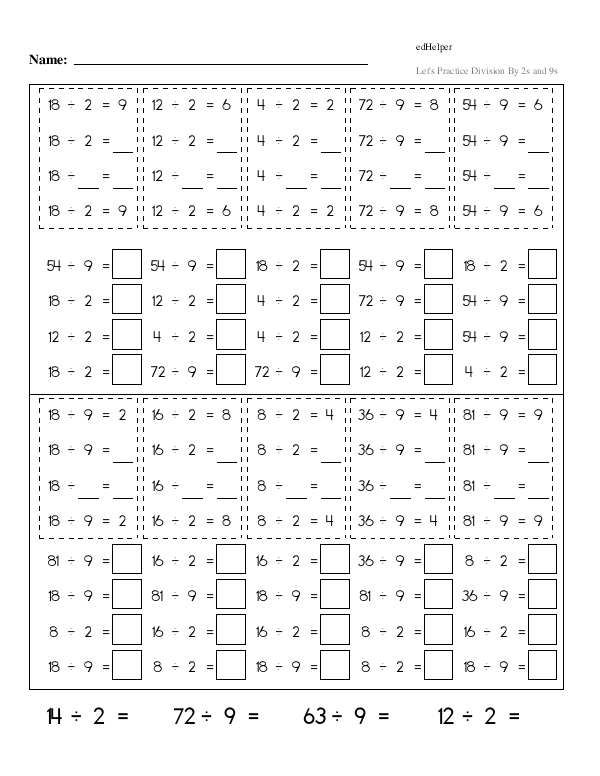
The worksheet "Division Fact Practice With Specific Divisors" is broken up into sections that enable students to practice division facts in different ways. Each page contains four horizontal sections. The first and third feature dashed lines where students practice a single division problem. The problem and answer are listed at the top and bottom. The second line asks students to fill in the answer, and the third line has them write the divisor and the answer. The second and fourth sections feature regular division problems displayed horizontally, where students write the answer in each box.
Each page asks students to practice different facts. For example, one page might say, "Let's Practice Division By 4s and 9s." Each set of problems goes together, too. So, the problems students practice in the first and third sections are mixed up for them to answer in the second and fourth sections, giving students targeted practice with specific divisors.
Memorizing division facts with single-digit divisors can help students become more proficient at solving basic problems. It also gives them a shortcut when solving more complex problems because they don't have to spend time solving basic division problems before they tackle the rest of the problem.
It can be helpful to have students practice sets of division problems to help with memorization. For example, you might list division problems that contain the number 2 as the divisor.
Don't shy away from giving students the answer while they're practicing. You can give them a cascading list of problems, where the first one lists the problem and answer, and they progressively fill in more blanks. For example, you might give them 24 ÷ 4 = 6, then 24 ÷ 4 = ___, then 24 ÷ ___ = ___.
Other ways to practice include mixing up division problems that are displayed horizontally and vertically, having students find the divisor when they're given the answer, and writing division sets, like 24 ÷ 4 = 6 and 24 ÷ 6 = 4.
Division Fact Practice With Specific Divisors
Division Fact Practice With Specific Divisors
GRADES:

Additional Educational Resources:
Estimation and Number Theory Large Workbook - (Grade 4)
Whole Number Multiplication and Division Large Workbook - (Grade 5)
Quick Assessment - Working with Small Factors: Multiplying and Dividing by 1-Digit