

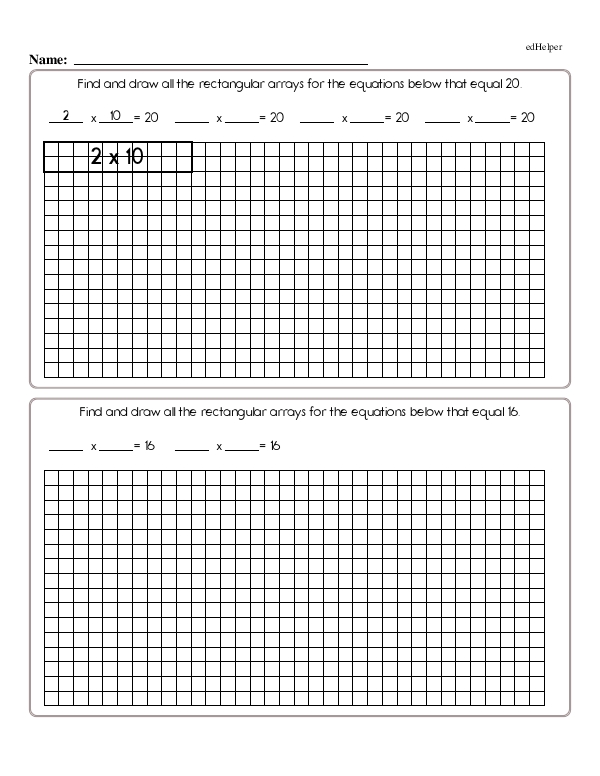
"Drawing Rectangular Arrays for Multiplication Problems That Have the Same Answer" features worksheet pages with large grids that contain 34 columns and 16 rows. Above each grid, there are multiplication problems that all equal the same answer. Students must fill in the factors for each problem before drawing the rectangular arrays in the grid for the equations. For example, a set of multiplication problems would be listed as "___x___=20." Students might write "2x10" or "4x5" in the blanks before drawing and coloring the matching arrays on the grid.
Each page features two grids with their own set of multiplication problems. Each box of grids also contains instructions, and the first grid on each page includes an example to show students how to do it.
Multiplication seems simpler for students who understand how different multiplication problems relate to each other, especially if they can visualize how to get the answer. You can help students build their understanding of multiplication by having them practice drawing arrays.
Provide students with a large piece of graph paper and ask them to draw arrays of different multiplication problems. Encourage students to compare and contrast their drawings. For example, they might notice that two problems like "2x9" and "9x2" have the same number of boxes, but the rows and columns are flipped. They could also notice that "6x3" has the same number of boxes but a different number of rows and columns.
You can expand learning even further by providing students with multiplication problems that all have the same answer but different combinations of factors to get each answer. They can then write their observations of the arrays that they drew.
Drawing Rectangular Arrays for Multiplication Problems That Have the Same Answer
Drawing Rectangular Arrays for Multiplication Problems That Have the Same Answer
GRADES:
Additional Educational Resources:
Multiplication (with one factor being larger than one digit) Large Workbook - (Grade 3)
Whole Number Multiplication and Division Large Workbook - (Grade 4)
Quick Assessment - Working with Small Factors: Multiplying and Dividing by 1-Digit