

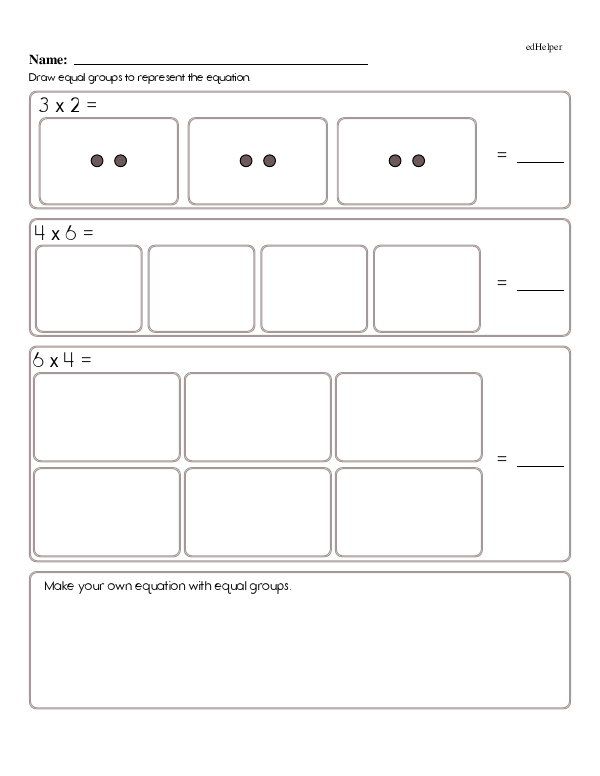
The worksheet titled "Drawing Repeated Addition to Represent Multiplication Problems" asks students to draw equal groups to represent multiplication equations. Each one features a series of empty boxes where students can draw the number of dots that represent each problem. For example, the equation "4x6=" includes four empty boxes where they can draw six dots. There is also an equal sign with a blank where they can write the answer. The first equation on each page displays the correct number of dots in each box so students can see how to complete the following problems.
The bottom of the worksheet invites students to make their own equation with equal groups. There is plenty of extra space where they can draw pictures that match the equation.
It's important for students to be able to see that multiplication is just repeated addition. You can do that by asking students to create equal groups that represent a multiplication problem.
Manipulatives are a great way for students to get started learning this concept. For example, when given the multiplication problem "9x5," students can create five piles of nine items. They can also create nine piles of five items, allowing them to experience the commutative property of multiplication.
Students can draw multiplication problems. They can draw simple shapes, like drawing five groups of nine dots to represent "9x5." You can invite students to draw whatever shapes they want to make the activity a bit more fun. You could also incorporate simple story problems for them to draw out.
Drawing Repeated Addition to Represent Multiplication Problems
Drawing Repeated Addition to Represent Multiplication Problems
GRADES:


Additional Educational Resources:
Multiplication Tables Large Workbook - (Grade 2)
Multiplication and Mental Math Large Workbook - (Grade 3)
Quick Assessment - Mastering Multiplication