

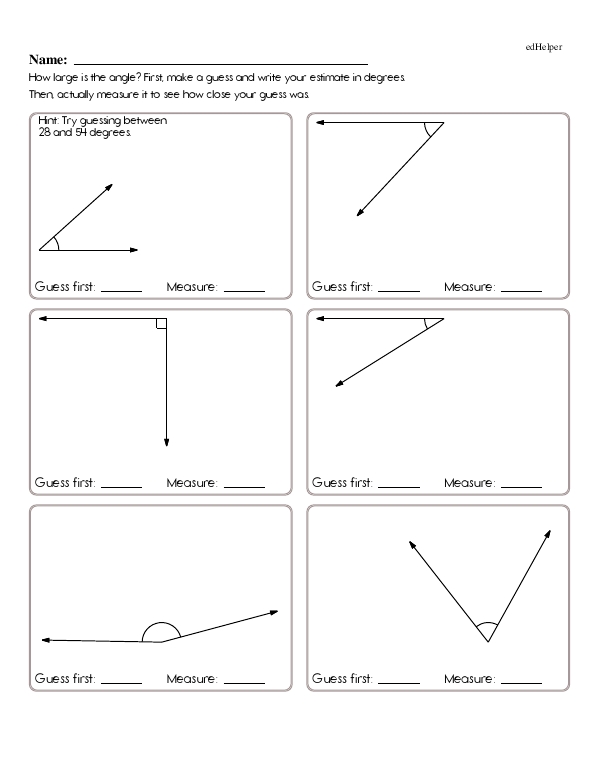
The worksheet titled "Estimating and Measuring Angles" displays six different angles. The instructions ask students to estimate the degrees of each angle and write down their guess first. Then, students actually measure the angle and see if their guess was close. The first one on each page gives students a hint. For example, it might say, "Try guessing between 25 and 52 degrees."
Each angle is contained within its own box with blanks for students to write their guess and the actual measurement. Angles are oriented in different ways to give students a challenge.
Learning how to measure angles is a critical math skill that helps students build their spatial and geometric understanding, in addition to everyday applications, like reading maps or estimating a turn while riding a bike. Giving students the tools, like a protractor, and skills to measure angles is an important first step, but it can also be helpful to have them estimate the measurement of an angle before they measure it. This can help them expand their understanding of angles that are greater than or less than benchmarks like 90 degrees.
To further challenge student thinking, present angles in different orientations for them to estimate and measure. You can also challenge them to figure out how to measure angles that are larger than 180 degrees.
Estimating and Measuring Angles
Estimating and Measuring Angles
GRADES:

Additional Educational Resources:
Angles Large Workbook - (Grade 5)
Properties of Triangles and 4-sided Figures Large Workbook - (Grade 5)
Quick Assessment - Number Sense: Estimation, Factors & Multiples