

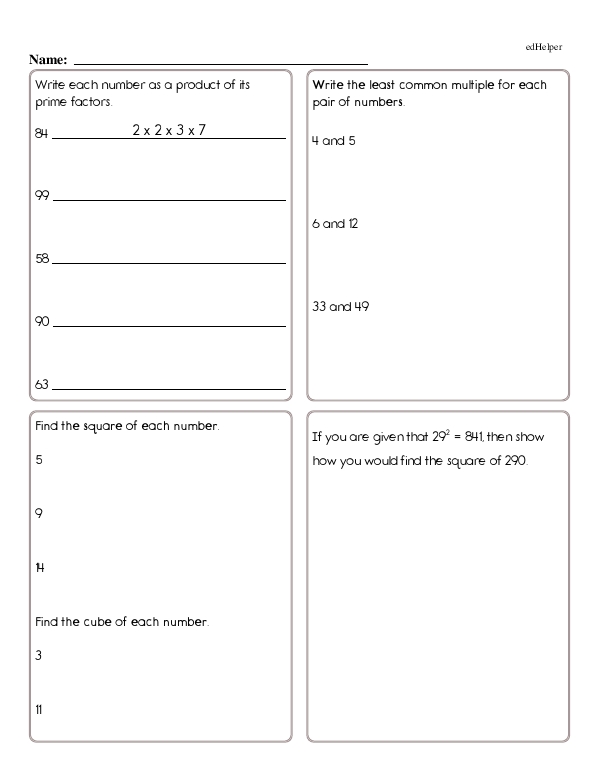
The worksheet titled "Factors, Multiples, Prime Numbers, and Exponent Practice" combines important concepts, giving students the ability to practice them together and see how they are similar and different.
Questions and problems on the worksheet include:
* Express a number as a product of its prime factors.
* Write the least common multiple for a pair of numbers.
* Find the value of an expression that includes an exponent.
* Write out the number as a product of its prime factors when the expression includes exponents.
* Show how to find the square of a number when you're given an equation with an exponent and the answer.
Each line of thinking is included within its own boundary. Some problems contain just one question, while others, like finding the value of an expression, may include multiple expressions for students to solve. Problems contain blank lines and empty space where they can write out their thinking and provide the answer.
Practicing related, but distinct, concepts like factors, multiples, prime numbers, and exponents can help students develop a greater understanding of mathematical principles. It can also encourage them to tackle problems in new and creative ways, since many mathematical concepts are related.
For example, students can work on writing a number as a product of its prime factors. So, a number like 304 could be written out as 2 x 2 x 2 x 2 x 19. Then, students could write the expression using exponents instead, which would be 24 x 19.
You could even develop an activity where students solve a problem and then have to find their partner. For example, one student would write 204 as a product of its prime factors, while another student writes the expression using exponents. Then, they have to mix and mingle with other students to find their match.
Students can practice identifying prime numbers, writing common multiples, and finding the value of expressions with exponents on the same page. Then, they could get together with a partner or in small groups to discuss how the problems are similar and how they are different.
Factors, Multiples, Prime Numbers, and Exponent Practice
Factors, Multiples, Prime Numbers, and Exponent Practice
GRADES:

Additional Educational Resources:
Algebraic Expressions Large Workbook - (Grade 6)
Whole and Prime Numbers Large Workbook - (Grade 6)
Quick Assessment - Whole-Number Workout: Ordering, Comparing, and Place Value of Large Values