

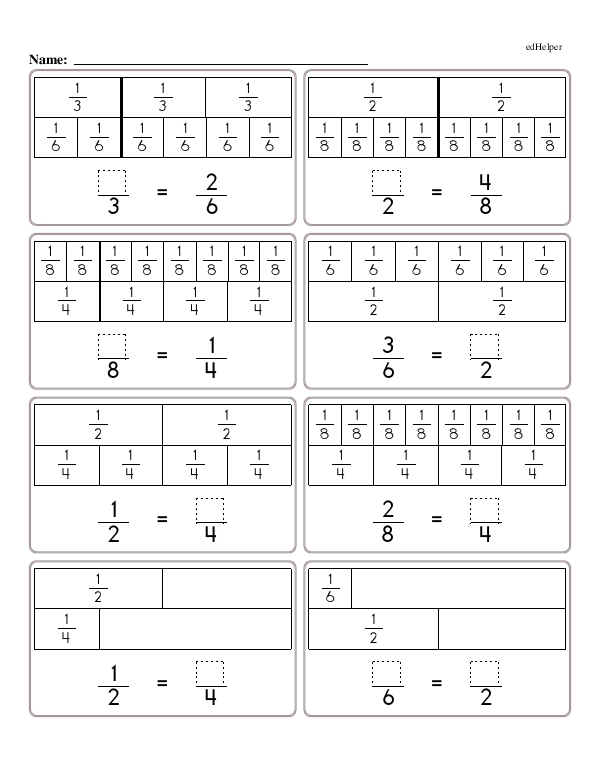
The worksheet titled "Find the Equivalent Fraction" is all about helping students see how one fraction equals another. At the top of each worksheet is an example that shows how fractions compare to each other. For example, two rectangles, each labeled 1/2, are situated above four smaller rectangles, each labeled 1/4. The problem shows: __/2 = 2/4. Students look at the visual to see that 1/2 is equal to 2/4.
As problems get more difficult, not all the fractions are filled in at the top of the page. For example, in order to find how many sixths are equal to 1/3, students have to draw out the thirds and sixths in the fraction pyramid above the problem. Additionally, some questions require students to find the numerators of both fractions.
Lower grade levels focus on smaller fractions and finding numerators. Upper-grade levels focus on bigger fractions, and some problems ask students to find the denominator instead of the numerator.
Learning equivalent fractions can help boost student comprehension of fractions and how they relate to each other. It's also a foundational skill for simplifying fractions and figuring out how to add, subtract, multiply, and divide fractions when they don't have common denominators.
It's a good idea to use visuals when learning about equivalent fractions because they allow students to see exactly how fractions relate to one another. You can use manipulatives, but you can also demonstrate equivalency by stacking fractions on top of each other in fraction pyramids on worksheets.
Give students the ability to compare equivalent fractions using different shapes, like rectangles or circles divided into equal sections. They should also be encouraged to draw their own pictures.
Simple questions can ask students to find the numerator in an equation like __/3 = 4/6. Other questions can ask students to find the denominator, or you can ask them to list 5 equivalent fractions for a starting fraction, like 3/4.
Find the Equivalent Fraction
Find the Equivalent Fraction
GRADES:
Additional Educational Resources:
Using Bar Models: Addition and Subtraction Large Workbook - (Grade 2)
Fractions Large Workbook - (Grade 3)
Quick Assessment - Fractions: Fraction Comparison and Easy Fraction Addition