

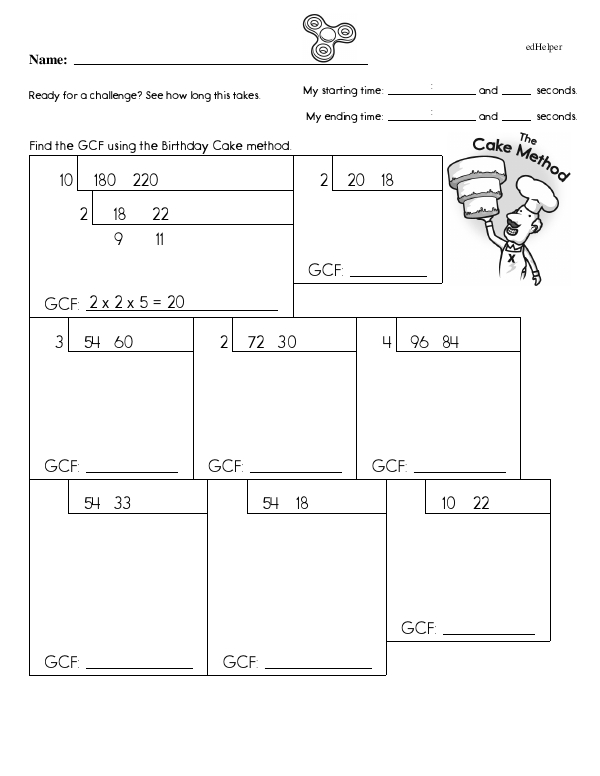
"Find the Greatest Common Factor: The Birthday Cake Method" is a worksheet that features 7 to 9 boxes where students use the Birthday Cake Method to find the greatest common factor. The directions tell students to "Find the GCF using the Birthday Cake Method." There is room at the top of the page for students to write their starting and ending times so they can see how long it takes them.
Each square contains two numbers enclosed in a rectangle, representing the bottom layer of the cake. Some also contain the first factor on the outside of the cake, while subsequent squares do not. For example, the first two numbers in the rectangle could be 50 and 40 with a factor of 2, while another square only lists the numbers 36 and 64, inviting students to come up with the first factor on their own.
Each square contains extra room where they can write all the layers of the cake, along with a space at the bottom where they can write the GCF. Each page starts with an example that contains all the numbers and the GCF to help students get started.
The Birthday Cake Method is a fun way for students to practice finding the greatest common factor because they don't have to choose specific factors in any order. For example, when finding the GCF for 32 and 44, students don't have to try 4 right away. Instead, they can use a factor of 2 and then see that 2 can be used again to get a GCF of 4.
It's a good idea to provide students with scrap paper or extra space on a worksheet where they can write out division problems, if needed. If you want to encourage students to use mental math, choose smaller numbers that are relatively easy to divide mentally. For example, both 60 and 80 can be divided by 2 and 10 mentally. If you want to use larger numbers, students can also practice using a calculator to find and fill in answers. This activity also supports broader questions about divisibility, like talking about how you know if a number is divisible by certain numbers, like 2, 5, and 10.
Find the Greatest Common Factor: The Birthday Cake Method
Additional Educational Resources:
Whole and Prime Numbers Large Workbook - (Grade 6)
Whole Number Multiplication and Division Large Workbook - (Grade 5)
Quick Assessment - Fraction Fluency: Multiply and Divide Fractions & Mixed Numbers
Quick Assessment - PEMDAS Power: Mastering the Order of Operations
Find the Greatest Common Factor: The Birthday Cake Method
GRADES:
Additional Educational Resources:
Whole and Prime Numbers Large Workbook - (Grade 6)
Whole Number Multiplication and Division Large Workbook - (Grade 5)
Quick Assessment - Fraction Fluency: Multiply and Divide Fractions & Mixed Numbers
Quick Assessment - PEMDAS Power: Mastering the Order of Operations