

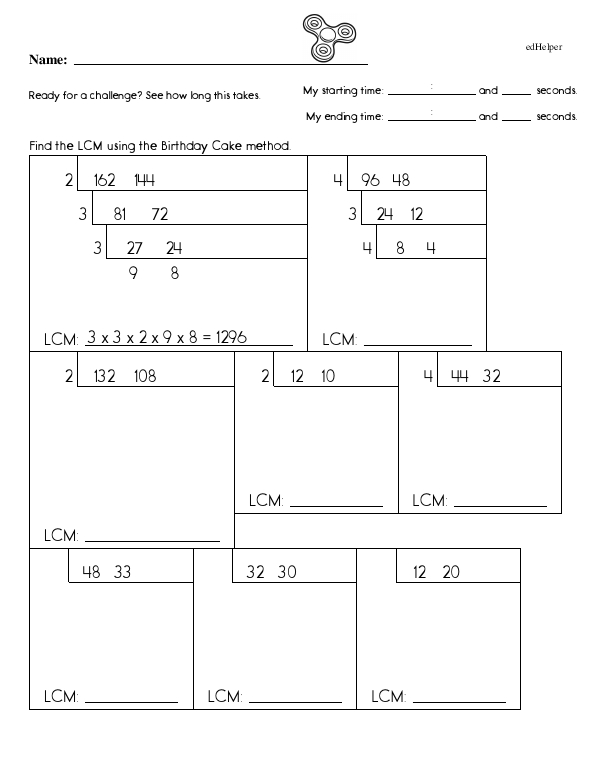
The "Find the Least Common Multiple: The Birthday Cake Method" worksheet challenges students to time themselves as they find the least common multiple of 7 or 8 pairs of numbers on each page. The instructions tell students to find the LCM using the Birthday Cake Method. There is room at the top of the page where they can write their starting and ending times.
Each pair of numbers is scaffolded with the two numbers in a large rectangle representing the bottom layer of the cake. In some problems, the first factor is provided outside the rectangle. The first problem has been completed on each page so students can see the Birthday Cake Method in action.
There is plenty of space in each square for students to write multiple layers of the cake. There's also a line at the bottom where students can multiply the appropriate numbers and write the least common multiple.
Adding and subtracting fractions is easier when students understand how to find the least common multiple. More broadly, learning how to find the least common multiple also helps students understand patterns and build a deeper understanding of number sense.
The Birthday Cake Method is a tool students can use to find the least common multiple. It involves listing numbers in pairs with factors on the left-hand side, making smaller layers as the numbers decrease until they no longer have a common divisor. Students can then multiply the factors and the leftover numbers to get the least common factor.
You can scaffold student thinking by giving them worksheets that have examples, as well as numbers and blanks that are set up like an upside-down birthday cake. Choose small or easily divisible numbers if you want students to use mental math. For example, both 360 and 270 can easily be divided by 10 and then 3 mentally. Students can practice their calculator skills if you choose higher or more difficult numbers, like 96 and 113.
Find the Least Common Multiple: The Birthday Cake Method
Additional Educational Resources:
Whole and Prime Numbers Large Workbook - (Grade 6)
Whole Number Multiplication and Division Large Workbook - (Grade 5)
Quick Assessment - Fraction Fluency: Adding, Subtracting, and Converting Mixed Numbers
Quick Assessment - Decimal Fluency: Real-Life Word Problems and Operations
Find the Least Common Multiple: The Birthday Cake Method
GRADES:

Additional Educational Resources:
Whole and Prime Numbers Large Workbook - (Grade 6)
Whole Number Multiplication and Division Large Workbook - (Grade 5)
Quick Assessment - Fraction Fluency: Adding, Subtracting, and Converting Mixed Numbers
Quick Assessment - Decimal Fluency: Real-Life Word Problems and Operations