

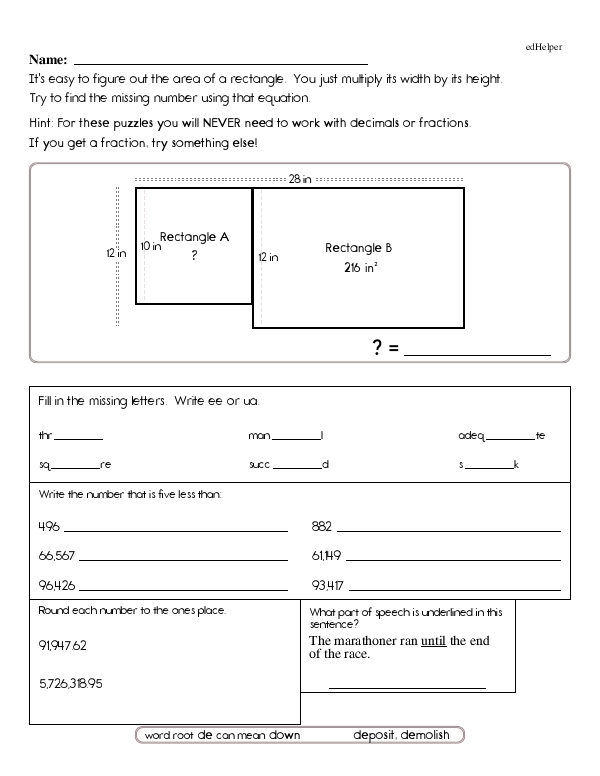
The worksheet called "Find the Missing Width or Height of Rectangles" uses the principles of finding area to challenge students to find the missing width or height of different rectangles.
The directions remind students that you find the area of a rectangle by multiplying its width by its height. Below is one rectangle or a configuration of a few different rectangles with their area listed inside. At least one width or one height is also given. The side they have to solve for is accompanied by a question mark, showing them which value to solve for.
There's extra room on the page for them to work out math problems that help them find the answer. The directions also state that the answer will never be a decimal or fraction, so they know to try again if they don't get a whole number.
Learning how to find the missing width or height of a rectangle teaches problem-solving skills, in addition to giving students practice with real-world problems. Give them the area of a rectangle and the measurement of one side so they can figure out the missing width or height.
You can turn the activity into a puzzle or a brainteaser by arranging different rectangles together and asking students to find missing widths and heights of smaller rectangles, as well as the total measurement of two or more rectangles together. Letting students plan a backyard garden, measuring the areas where certain plants are going to grow, can also be a fun, real-world way to give them practice finding lengths, widths, and areas.
Find the Missing Width or Height of Rectangles
Find the Missing Width or Height of Rectangles
GRADES:


Additional Educational Resources:
Polygons Large Workbook - (Grade 6)
Whole Number Multiplication and Division Large Workbook - (Grade 5)
Quick Assessment - Solving Simple Inequalities: Exploring One- and Two-Step Inequalities