

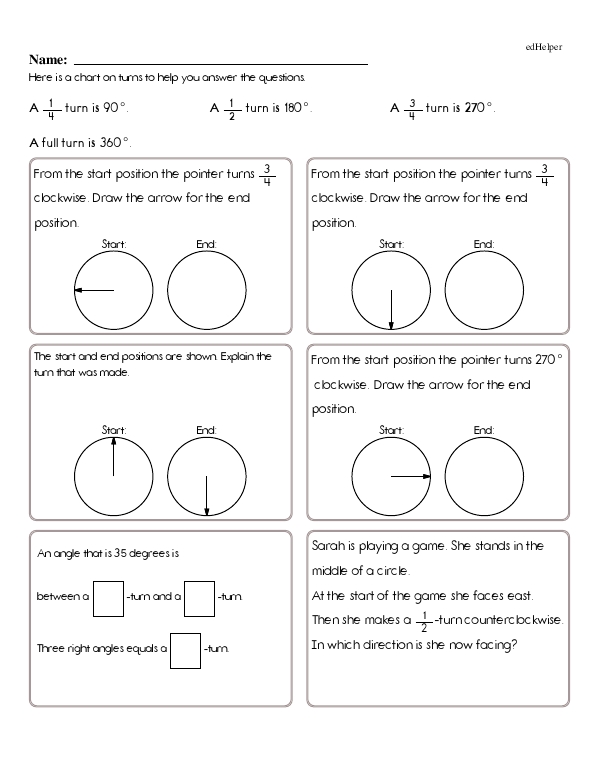
"Following Directions to Draw an Arrow in a Circle: Combining Fractions and Angles" is a worksheet that gives students fraction directions to figure out where a starting arrow ends up inside a circle. For example, one question reads, "From the start position, the pointer turns 3/4 clockwise. Draw the arrow for the end position."
There are two separate circles for each problem. One circle shows the start position, and the blank circle is where students draw the end position. Each worksheet also includes a chart that tells students the value of each fractional turn in 1/4 increments. So, for example, a 1/4 turn equals 90 degrees, and a 3/4 turn equals 270 degrees.
Other questions follow the same theme but are slightly different. For example, one problem might show the start and end positions in two different circles, asking students to explain the turn that was made. Another might feature a word problem that asks students to figure out which way a student is facing after a series of turns or what two angle measurements a given value is located between.
Connecting math concepts like fractions and angle measurements to real-world examples can help students understand them better.
For example, asking students to visualize a turn can help them see angles and fractions in the real world. They can work with a partner and take turns standing and facing different directions depending on the instructions. For example, they could start by facing the front of the classroom, then turn 3/4 counterclockwise, where each wall equals 1/4, and write down which way they're facing now. The same activity can be repeated on a worksheet with arrows in circles to show the directions they are facing. They can then measure the angle created by the starting and ending arrows.
Spinner games can be fun, with students spinning a spinner to turn an object, or students can solve a word problem that helps the person in the problem navigate a simple map.
Following Directions to Draw an Arrow in a Circle: Combining Fractions and Angles
Following Directions to Draw an Arrow in a Circle: Combining Fractions and Angles
GRADES:
Additional Educational Resources:
Fractions and Decimals Large Workbook - (Grade 6)
Angles Large Workbook - (Grade 5)
Quick Assessment - The Decimal Toolbox: Adding and Subtracting Money and Decimals
Quick Assessment - From Decimals to Fractions: A Conversion Challenge