

"Fraction Word Problems With Addition, Subtraction, and Hand-Drawn Models" worksheet pages encourage students to practice their problem-solving skills by reading and solving word problems that involve fractions. Each worksheet follows a similar pattern of questions, mixing up the numbers on each page to provide students with plenty of practice.
Questions include:
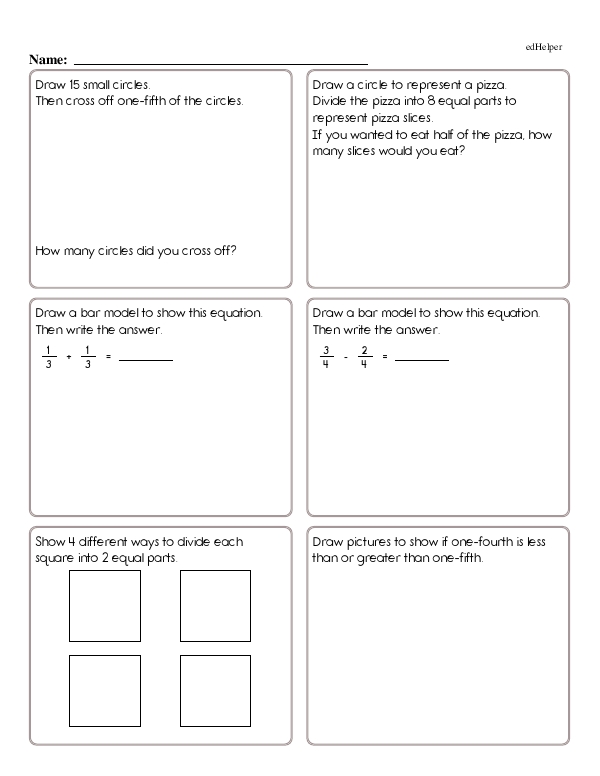
* Draw a certain number of circles, cross out a fraction of the circles they drew, and write down how many circles they cross off.
* Drawing a circle to represent a pizza before asking students to divide it into equal parts. Then they answer how many slices they would eat if they ate a certain fraction of the pizza.
* Asking students to draw bar models to find the answer to addition and subtraction problems.
* Showing four different ways to divide a square into a certain number of equal parts.
* Drawing pictures to show which of two fractions is greater and which one is smaller.
Each page contains six questions. Each question is divided into its own section with an outline in the shape of a square so students can clearly write out their thinking in the allotted space for each problem.
Word problems are a great way to encourage kids to think about math in real-world situations. They can also support critical thinking skills and visualization, which are both important when it comes to solving addition and subtraction problems with fractions.
For example, word problems can get students to think about fractions as part of a set, like asking them to draw a certain number of equal shapes before crossing off a fraction of the shapes they drew. You can get students to think about fractions as parts of a whole by asking them how much pizza they ate if they ate a certain fraction of the entire pizza.
It can be especially powerful to ask students to show different ways to display equal fractions. For example, they can divide a square into four equal parts by drawing four equal squares, four equal horizontal lines, or four vertical lines. Drawing pictures can also help students compare fractions with unlike denominators to see which one is bigger and which one is smaller.
Fraction Word Problems With Addition, Subtraction, and Hand-Drawn Models
Additional Educational Resources:
Fractions and Mixed Numbers Large Workbook - (Grade 4)
Fractions and Mixed Numbers Large Workbook - (Grade 5)
Quick Assessment - Fractions: Fraction Comparison and Easy Fraction Addition
Quick Assessment - Easy Fraction Frenzy Introduction: Coloring, Comparing, and Calculating
Fraction Word Problems With Addition, Subtraction, and Hand-Drawn Models
GRADES:
Additional Educational Resources:
Fractions and Mixed Numbers Large Workbook - (Grade 4)
Fractions and Mixed Numbers Large Workbook - (Grade 5)
Quick Assessment - Fractions: Fraction Comparison and Easy Fraction Addition
Quick Assessment - Easy Fraction Frenzy Introduction: Coloring, Comparing, and Calculating