

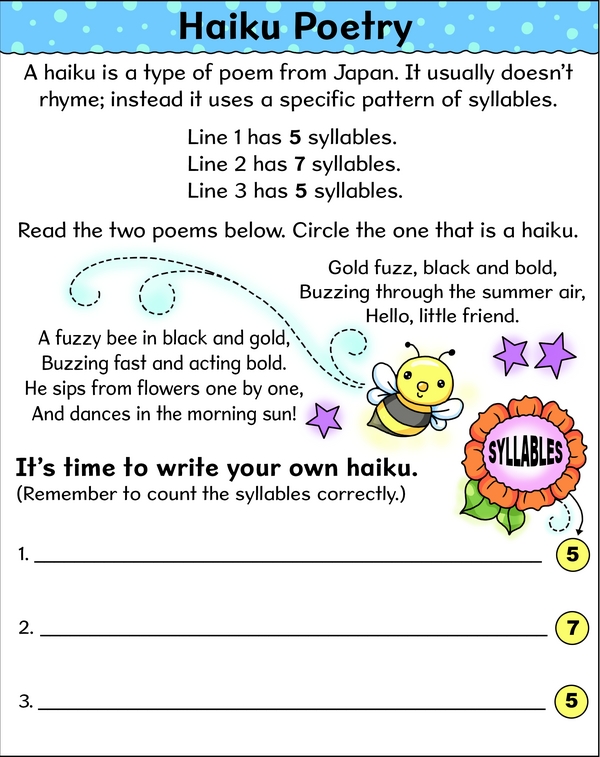
Haikus are a special type of poem. They don't need to rhyme. Each haiku has just three lines and follows a 5-7-5 syllable pattern. In this worksheet, first read both poems and circle the one that is a haiku. Then try writing one of your own!
Haiku 5-7-5: Three Lines of Magic
Additional Educational Resources:
Syllable Splitting Practice: Vowel-Consonant/Consonant-Vowel Pattern
Mastering Adjectives: Exploring Synonyms for Good and Bad
Get Acquainted with Prepositions
Changing Verbs Ending in Y from Future to Present
Turkey Tales: Giving Thanks
Finish the Story - The Case of the Missing Cupcake
Stretching Exercise: Step by Step
Suffix Mastery: Creating Words with Roots
Haiku 5-7-5: Three Lines of Magic
GRADES:
Additional Educational Resources:
Syllable Splitting Practice: Vowel-Consonant/Consonant-Vowel Pattern
Mastering Adjectives: Exploring Synonyms for Good and Bad
Get Acquainted with Prepositions
Changing Verbs Ending in Y from Future to Present
Turkey Tales: Giving Thanks
Finish the Story - The Case of the Missing Cupcake
Stretching Exercise: Step by Step
Suffix Mastery: Creating Words with Roots