

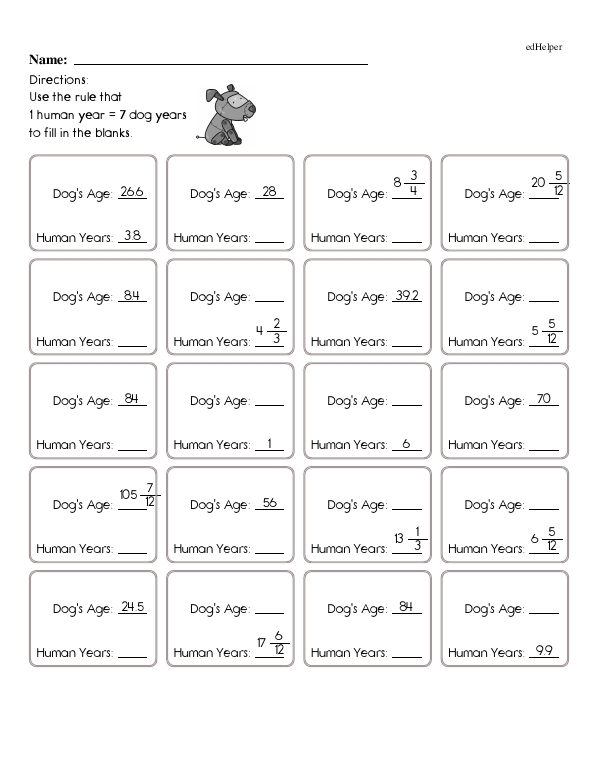
"Human Years and Dog Years Conversions With Fractions and Decimals" is a worksheet that gives older students a challenge converting human years to dog years using multiplication or dog years to human years using division by incorporating decimals and fractions.
Each page starts with directions that state "Use the rule that 1 human year = 7 dog years to fill in the blanks." There are 20 total boxes on each page that have blanks for human years and the dog's age. The first box has both blanks filled in as an example. Every other box on the page has one line filled in, so students either have to figure out the dog's age based on human years or the human years based on the dog's age. For example, one box might state that the human years equal 3 2/3, and students have to find the dog's age. Another box might state that the dog's age equals 48.3 years, and students have to figure out the human years.
Using rules can be an effective way for students to practice fraction and decimal skills, as well as multiplication and division skills, while also incorporating opportunities for them to practice their critical thinking skills.
For example, you can give students the rule that 1 human year equals 7 dog years, but instead of using whole numbers, you can use decimals. So, students might see that the human years equal 4.5, and they have to figure out how old the dog would be.
Another activity could include a smoothie shop that charges $0.50 for the first 8 ounces, $0.40 for the next 8 ounces, and $0.30 for every ounce after that. Students could figure out how much different-sized drinks cost. As students get the hang of it, you could invite them to create their own math rules and exchange problems with another student.
Human Years and Dog Years Conversions With Fractions and Decimals
Additional Educational Resources:
Fractions and Decimals Large Workbook - (Grade 6)
Multiplying and Dividing Fractions and Mixed Numbers Large Workbook - (Grade 5)
Quick Assessment - Number Sense Spotlight - Rational Numbers in Action: Fractions, Decimals, and Common Factors
Quick Assessment - Fraction Fluency: Multiply and Divide Fractions & Mixed Numbers
Human Years and Dog Years Conversions With Fractions and Decimals
GRADES:

Additional Educational Resources:
Fractions and Decimals Large Workbook - (Grade 6)
Multiplying and Dividing Fractions and Mixed Numbers Large Workbook - (Grade 5)
Quick Assessment - Number Sense Spotlight - Rational Numbers in Action: Fractions, Decimals, and Common Factors
Quick Assessment - Fraction Fluency: Multiply and Divide Fractions & Mixed Numbers