The worksheet "Identifying Consonants, Vowels, and Adding -ING to Words" features two different sections for students to complete.
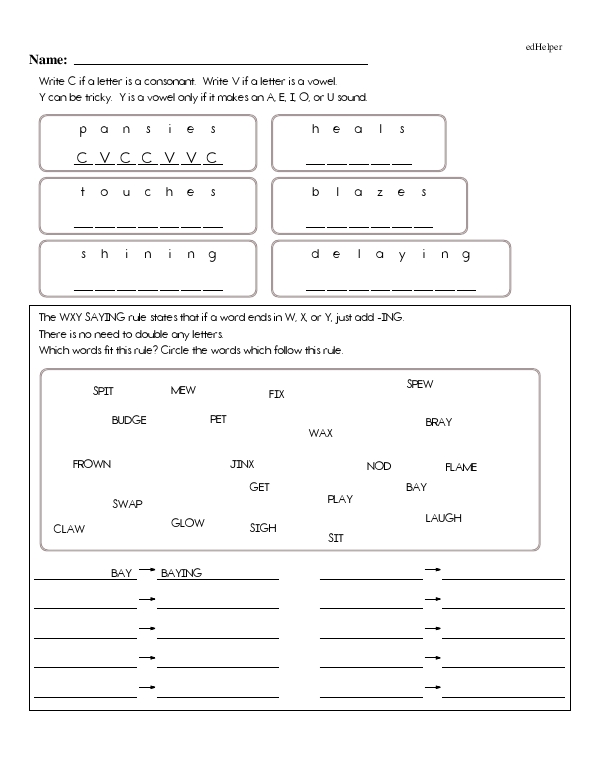
The first section features words with blanks underneath each individual letter. Students write the letter C on the blank if the letter above is a consonant or V if the letter above is a vowel. The directions at the top tell students what to do, which includes telling them that the letter Y should be labeled as a vowel if it makes an A, E, I, O, or U sound.
The next section asks students to write words with ING. Directions remind students about the WXY Saying. Lower grade levels use this rule as a reminder that letters do not need to be doubled. They circle the words floating in a small rectangle that follows this rule and write the base word along with the word including ING.
Higher grade levels get the same reminder about the WXY Saying, but instead of finding words that follow that rule, the directions ask students to look closer at whether the word ends with a consonant-vowel-consonant (CVC). Then, it instructs them to double the last letter before adding ING down below.
Both sections include examples so students can see how to get started.
Learning how to identify letters as consonants or vowels can help students figure out the best way to transform words by adding different endings. For example, the WXY Saying teaches students that ING can be added to those words, but if the last three letters of a word follow the consonant-vowel-consonant (CVC) pattern, the last letter needs to be doubled first.
Students should practice these rules separately. Younger grade levels can practice adding ING to words that end in W, X, and Y, while higher grade levels can work on identifying words that end with CVC and double the last letter before adding ING. When students have mastered both skills, you can create an activity that combines both, asking students to figure out which words need a double last letter and which ones don't before adding ING.
Identifying Consonants, Vowels, and Adding -ING to Words
Identifying Consonants, Vowels, and Adding -ING to Words
GRADES: