

The worksheet titled "Identifying and Adding Coins and Dollars" features small, medium, and large boxes filled with different representations of money. In some boxes, students identify the value of a coin or a paper bill. Some boxes show multiple coins, multiple bills, or both that students have to add. Worksheets have a mix of actual coins and bills, as well as bills and coins that are labeled with their value. Some boxes have the amount filled in so students can see an example.
This worksheet goes even further to help students identify bills and coins by showing their fronts and backs. That way, students learn how to identify bills and coins from both sides.
Learning how to identify and add money is an important real-life skill that students need to learn. It remains important in a digital world, as students are better able to learn the value of money when identifying and counting it out, compared to seeing digits on a screen.
It's helpful to start with manipulatives so students can practice counting money like they would in real life. Creating a class store is a fun way for students to practice counting money, but you can also have them count play money during a math lesson.
As students get more familiar with identifying and counting money, you can show pictures of coins on worksheets that they have to label and count. This strategy is especially effective if you display the backs of coins and bills so students get practice identifying both sides. Eventually, you can incorporate high-level math concepts, like determining whether one set of coins is greater than or less than another set of coins, and identifying fractions of a dollar, like what fraction of a dollar is three-quarters?
Identifying and Adding Coins and Dollars
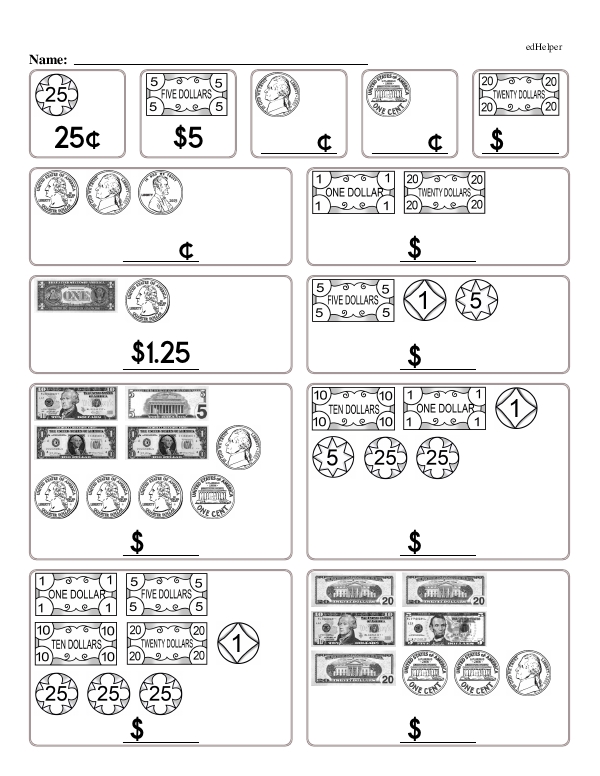
Identifying and Adding Coins and Dollars
GRADES:

Additional Educational Resources:
Decimals Large Workbook - (Grade 4)
Money Large Workbook - (Grade 1)
Quick Assessment - Money Challenge (difficult): The Ultimate Coin & Dollar Challenge
Quick Assessment - An Introduction to Fractions: Visualizing Fractions