

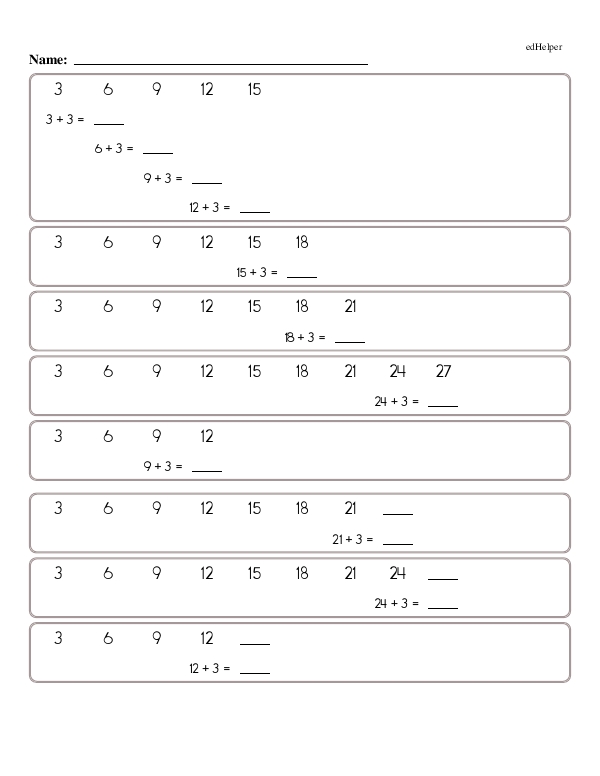
"Learning to Skip Count With Addition" is a worksheet that helps students learn the mechanism behind skip counting by using addition. Each worksheet page focuses on skip counting by different numbers that include 2, 3, 4, 5, and 8, with each worksheet focusing on a different digit.
The top of the page shows strings of numbers that are skip-counted, starting with the same number, but each string ends at a different number. Addition problems accompany each string that show how the last number was created. For example, one string of numbers might show 4, 8, 12, 16, 20. The accompanying math problem is 16+4=___. Students fill in the answer as the final number in the series.
Some worksheets show every step of the process. For example, the string 3, 6, 9, 12 is accompanied by the math problems 3+3=, 6+3=, and 9+3=___.
The bottom of some pages uses repetition to help students memorize addition facts. It might repeat problems like 6+3 and 3+3 ten times, having students fill in the answers in a square.
Skip counting is an important skill to learn because it forms the basis of multiplication. It can also help students practice math facts by seeing each number in a series as the answer to an addition problem.
For example, you could give students the series 5, 10, 15, 20, 25, and ask them to write the addition problem that accompanies each number. So, they would write 5+5=10, 10+5=15, and so on. Students can work with the same number line and predict which number comes after another. So, if they're counting by 5s, they could show which math problem would represent an answer of 50.
Repetition can be helpful too. When working with 3s, students can complete math problems that include 3, like 3+3 and 6+3. You could even do a version of a timed math test, but instead of having students answer the problems, you could give them a sheet with all the math facts and answers already filled in. Then, they reference those math facts to fill in the worksheet. This encourages them to learn their math facts visually instead of counting by ones to find the answer.
Learning to Skip Count With Addition
Learning to Skip Count With Addition
GRADES:

Additional Educational Resources:
Addition up to 1,000 Large Workbook - (Grade 2)
Making Groups (Multiplication and Division Ideas) Large Workbook - (Grade 1)
Quick Assessment - Two-digit and Three-digit Addition - Bigger Numbers, Bigger Sums