

The worksheet titled "Math Crossword Puzzles: Addition, Subtraction, Multiplication, and Division Practice" looks like a crossword puzzle, but instead of featuring letters and words, it features math problems. Some numbers and answers are filled into each equation, and some aren't. Students must fill in the missing numbers, equal signs, and mathematical operator symbols that can include addition, subtraction, multiplication, and division. All of the missing numbers and symbols are listed in a number bank at the top so students can cross them off as they are used, helping them to double-check their work as they fill in the boxes.
Crosswords become more complex in higher grade levels with subtraction, multiplication, and division making an appearance when it's appropriate for the grade level. More complex problems may also include running addition, as well as problems that have another equation for an answer. For example, one math problem in the puzzle might be 3 + 6 = 14 - 5.
Puzzles and brain teasers can be a fun way for students to practice their math facts, as well as problem solve and think critically. For example, a word find-style puzzle encourages students to search for and find math facts when they're jumbled up with a bunch of different numbers.
Crossword-style puzzles can be effective because they also demonstrate how different numbers and equations relate to each other. The numbers in a math crossword might be included in an addition problem in one direction and a subtraction problem in another direction. They can also help students practice different kinds of problems, like running addition problems that have more than two addends. Students can even discover equations that equal other equations, like 12 - 7 = 8 - 3.
It's helpful to give students a head start by filling in some numbers and mathematical operations symbols. You can also include a number bank at the top with all of the missing numbers and symbols so students can cross them out as they go along.
Math Crossword Puzzles: Addition, Subtraction, Multiplication, and Division Practice
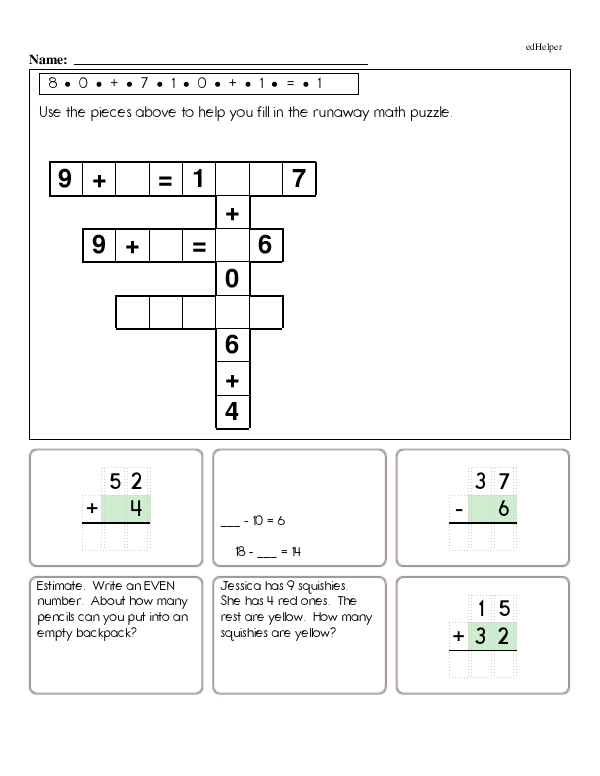
Math Crossword Puzzles: Addition, Subtraction, Multiplication, and Division Practice
GRADES:
Additional Educational Resources:
Subtraction Up to 10,000 Large Workbook - (Grade 3)
Addition up to 1,000 Large Workbook - (Grade 2)
Quick Assessment - Easy Lightning-Fast Subtraction Problems
Quick Assessment - Multiply 1, 2, or 10: Simple Steps to Multiplication Success