

The worksheet titled "Measurement Word Problems With Visual Aids" uses visual aids and word problems to help students practice measuring distances. Each worksheet contains four problems.
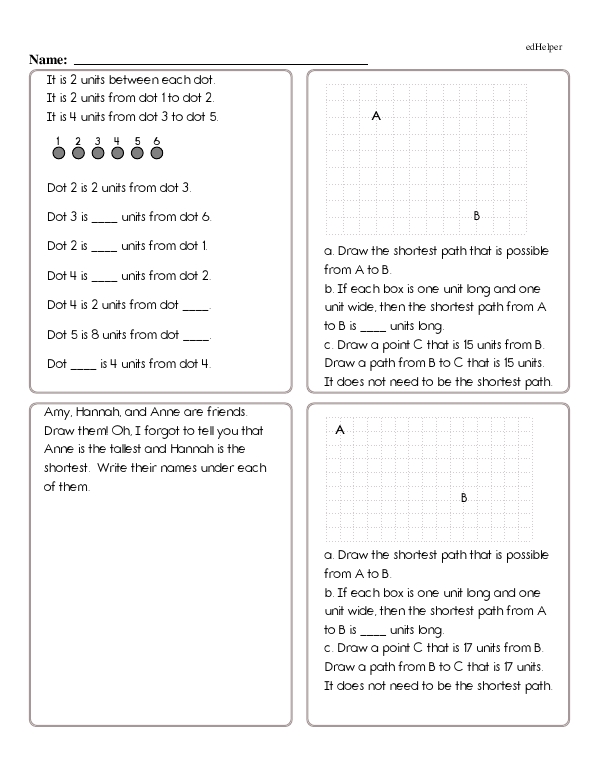
One problem on each page features a series of dots that are labeled with numbers. The dots are accompanied by instructions that say, "It is 2 units between each dot. It is 2 units from dot 1 to dot 2. It is 4 units from dot 3 to dot 5." Students use the series of dots to fill in the blanks below. For example, they would fill in the blank for "Dot 3 is ____ units from dot 2."
Two of the problems on each page feature a grid with a point labeled A and another point labeled B. The directions ask students to draw the shortest path between the two points before asking them to measure how many units long the line is. They also draw a point C according to the number of units it is away from B.
Each page also includes one simpler word problem that asks students to draw three friends according to directions that state who is the tallest and the shortest.
Measuring includes much more than just measuring distance on a ruler. Students must practice measuring in many different ways to fully grasp the concept of measurement, which will help them tackle more complex math in higher grade levels.
One of the easiest ways to begin measuring is to use a number line or a series of dots. Young students can determine how far away one digit is from another, like how many digits are between 3 and 8.
You can customize word problems based on the knowledge level of your students. For example, they can draw three friends after the instructions tell them who is the tallest and who is the shortest. You can make it more difficult by increasing the number of friends in the problem.
Grids and graphs can be a handy way to practice measurement, too. Students can count the number of boxes between two points or draw additional points according to how many boxes they are away from other points on the grid.
Measurement Word Problems With Visual Aids
Measurement Word Problems With Visual Aids
GRADES:
Additional Educational Resources:
Length Large Workbook - (Grade 1)
Real-World Problems: Measurement Large Workbook - (Grade 3)
Quick Assessment - Geometry Puzzles: Exploring Shape Patterns