

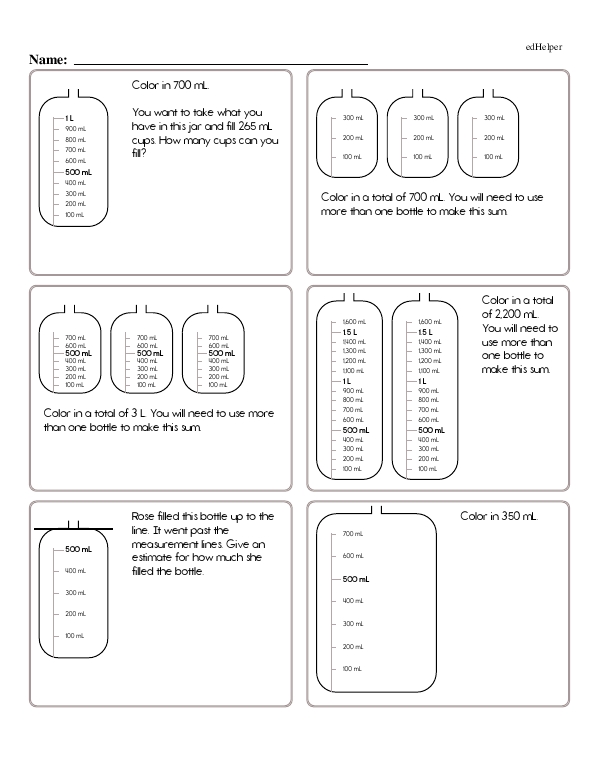
"Measuring Milliliters in Bottles and Answering Questions" is a worksheet that displays images of empty bottles that are labeled with milliliter (mL) measurements. Different sets of bottles ask students different questions. They can include:
* How many cups can you fill if you have a certain amount in the bottle and cups hold a given amount?
* Asking students to color in a large milliliter total, like 1,100 mL, that requires them to color more than one bottle.
* Coloring in a certain amount of liquid in a bottle, even if that amount isn't displayed. For example, asking them to color in 140 mL when labeled numbers are measured in hundreds.
* Estimating the amount in a bottle that is overfilled, and the measurement labels don't continue to the top.
Different questions include their own sets of bottles within square-shaped boundaries, so students don't get them mixed up. Most questions ask students to color in an amount to support visual learning.
Learning how to measure volume is a practical skill that can be applied to science, math, and daily life. Students can begin, especially in a subject like science, by pouring different amounts of liquids into different containers. They can visually see how different containers can hold different amounts of liquids, they can combine liquids, and they can estimate their volume by sight.
Less messy activities can include worksheets, as long as there's a visual component, at least at first. For example, bottles with milliliter (mL) markings can be displayed, and students can be instructed to color in different amounts. They can color in a large amount on multiple bottles or estimate where a liquid would fall in a bottle, like 270 mL on a bottle that displays mL amounts in hundreds.
Measuring Milliliters in Bottles and Answering Questions
Measuring Milliliters in Bottles and Answering Questions
GRADES:
Additional Educational Resources:
Estimation and Number Theory Large Workbook - (Grade 4)
Decimals Large Workbook - (Grade 5)
Quick Assessment - Number Sense: Estimation, Factors & Multiples
Quick Assessment - Decimals and Fractions: The Fraction-Decimal Connection