

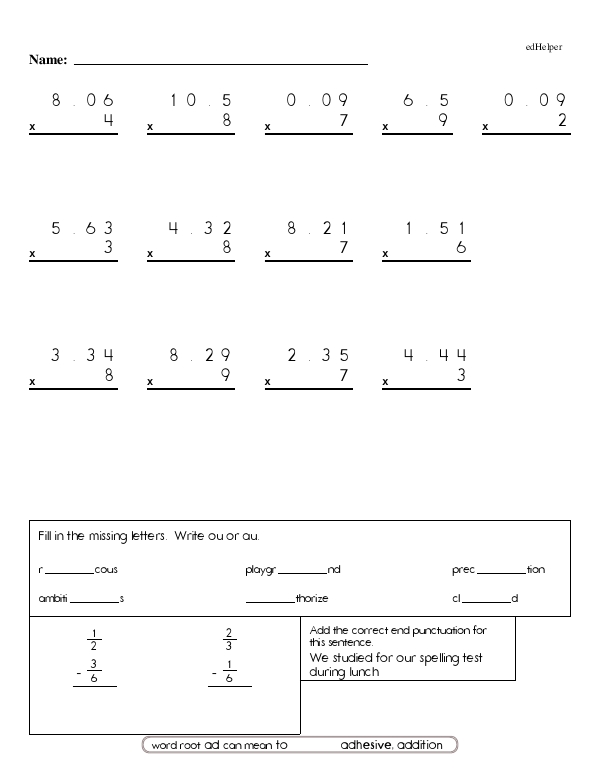
"Multiplying Decimals Practice: Whole and Decimal Factors" is a worksheet that provides students with repeated decimal multiplication practice.
Pages contain 12 or 13 problems. They are displayed vertically so students can write down each step of the answer and the numbers they carry from each column. Each problem contains one whole number on the bottom and a decimal number on the top. Most are two or three digits long, like 5.2 and 9.27. There are a few problems that contain four digits, like 50.03, but all feature two whole digits, never three or four whole digits in the hundreds or thousands.
Students must learn how to multiply decimals because it helps them develop number sense that can seem counterintuitive on the surface. For example, multiplying a decimal like 0.5 makes a number smaller and not larger. It can help students calculate money, and it prepares them for higher-level math, like algebra and geometry.
Repetition is helpful once students understand how to solve problems but need to develop confidence. Start with problems that are easier to tackle, like multiplying a whole-digit number by a small decimal, like 1.2. As they get more practice, decimal factors can get larger, and students can eventually try multiplying two decimals.
You can help students grasp the real-world concept of multiplying decimals by incorporating money. They can answer word problems that ask them to multiply an amount. For example, if it costs $3.75 to make one bracelet, how much will it cost to make nine?
Multiplying Decimals Practice: Whole and Decimal Factors
Additional Educational Resources:
Fractions and Decimals Large Workbook - (Grade 6)
Multiplying and Dividing Decimals Large Workbook - (Grade 5)
Quick Assessment - Algebra Expressions and Equations Challenge: Combining Like Terms & Finding the Unknown
Quick Assessment - From Fractions to Decimals (and Back) and their Place Value
Multiplying Decimals Practice: Whole and Decimal Factors
GRADES:

Additional Educational Resources:
Fractions and Decimals Large Workbook - (Grade 6)
Multiplying and Dividing Decimals Large Workbook - (Grade 5)
Quick Assessment - Algebra Expressions and Equations Challenge: Combining Like Terms & Finding the Unknown
Quick Assessment - From Fractions to Decimals (and Back) and their Place Value