

Students will engage with skills related to understanding integers on this math practice page. They will practice translating everyday scenarios into integers by identifying positive and negative numbers represented by actions such as changes in temperature, movement on a number line, and variances in stock market points. Students will also work on recognizing the opposite of given integers. For example, kids might be asked how to represent the deposit of $1,784 into a bank account. When you deposit $1,784 into a bank account, you add that amount of money to the balance in your account. Imagine your bank account as a piggy bank that keeps track of how much money you have. If you had no money in your account, your new balance would be $1,784. If you already had some money, you'd need to add $1,784 to whatever amount you already had. Another example is finding the opposite of an integer, such as the opposite of -122. Finding the opposite of an integer is like thinking of its mirror image on a number line. If you have the number -122 and want to see its opposite, you change the sign in front of it. Numbers with a minus sign, like -122, are on the left side of zero on a number line. To find the opposite, move to the same distance on the right side of zero. So, the opposite of -122 is 122.
Navigating Numbers: Understanding Integers
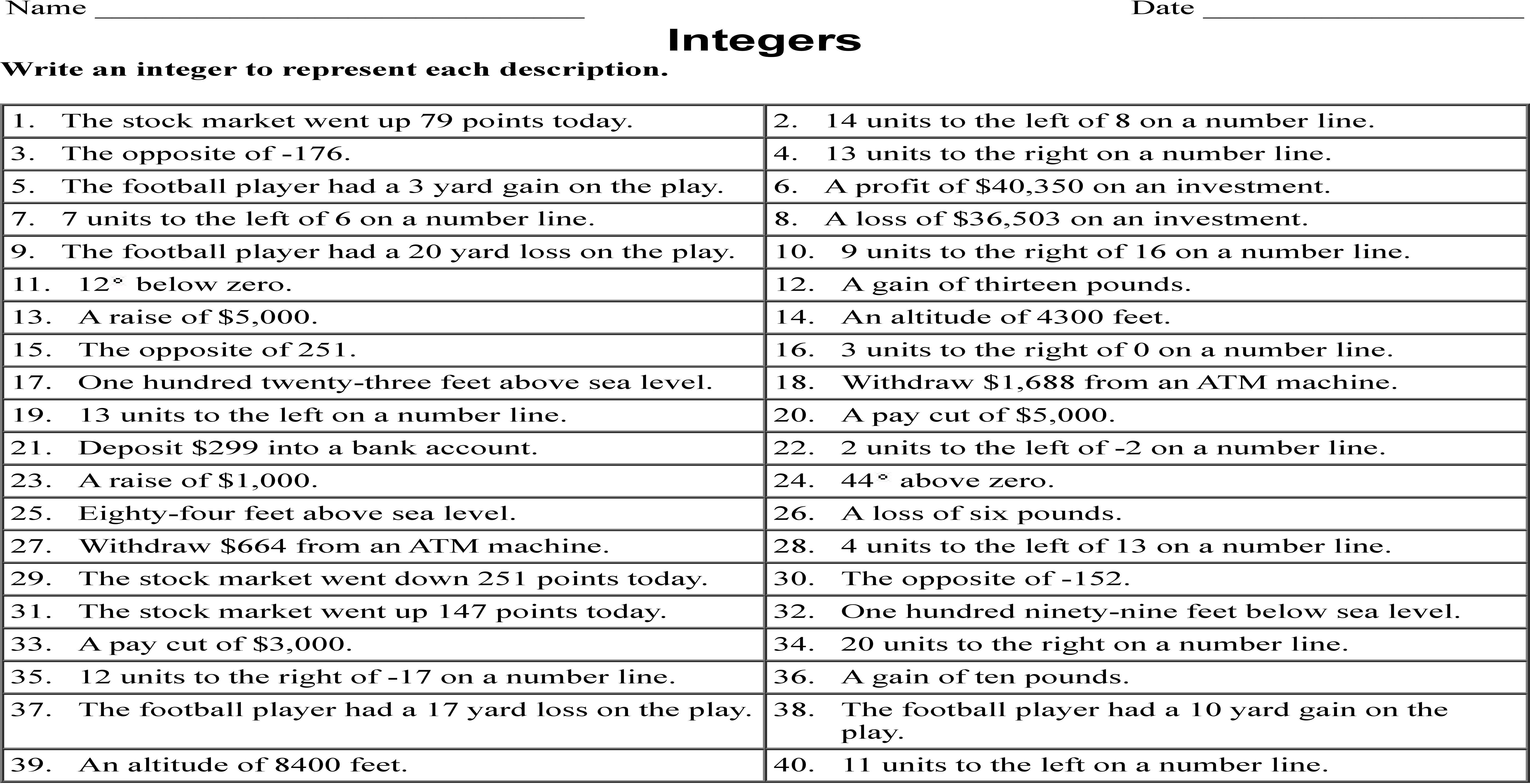
Navigating Numbers: Understanding Integers
GRADES:
Additional Educational Resources:
Equations and Inequalities Large Workbook - (Grade 6)
Number Lines and Negative Numbers Large Workbook - (Grade 6)
Quick Assessment - Mastering Percent Calculations: Real-World Percents