

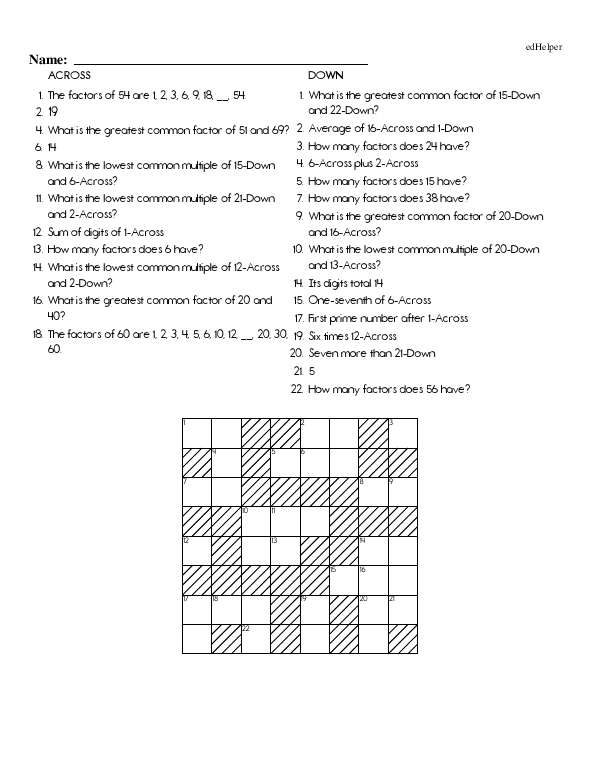
This math cross puzzle focuses on factoring, greatest common factors, lowest common factors, and other relevant skills. The top of each page categorizes problems as "Across" or "Down." Each question is numbered, with each number corresponding to the boxes students write in on the cross puzzle below.
Some of the factor-related problems students must solve include:
* What's the greatest common factor of 14 and 77?
* How many factors does 10 have?
* The factors of 30 are 1, 2, 3, 5, 6, ___, 15, 30.
Other types of review questions are sprinkled in too. For example, students might be asked to find a prime number. Questions also combine the answers from other questions. For example, students might solve "Seven times 4-Down."
Some answers are already given. Students fill them in and see if they match the other numbers they wrote in the puzzle. If they don't match up, they know they have to go back and try again.
Being able to factor numbers is a foundational skill that will help students with fractions and simplifying algebraic expressions in the future. It can also help students understand numbers more in-depth instead of simply memorizing the answers to math problems. For example, they can see that 24 isn't just 3 x 8, but that it can also be 4 x 6 and 2 x 12.
Students can practice listing the factors of numbers, but they should also be able to identify the greatest and least common factors of two numbers. Students can also learn how to find the lowest common multiple of two numbers or fill in the missing number in a series to expand their thinking.
Worksheets are a great way for students to review these concepts, but they can also complete a puzzle or play a game. If students need some support, consider pairing them up to complete a worksheet together so they can learn from each other.
Number Cross Puzzle: Factoring, GCF, and LCF
Number Cross Puzzle: Factoring, GCF, and LCF
GRADES:
Additional Educational Resources:
Whole Number Multiplication and Division Large Workbook - (Grade 5)
Whole Numbers Large Workbook - (Grade 5)
Quick Assessment - Fraction Fluency: Multiply and Divide Fractions & Mixed Numbers
Quick Assessment - Building Blocks of Numbers: Exploring Whole Numbers