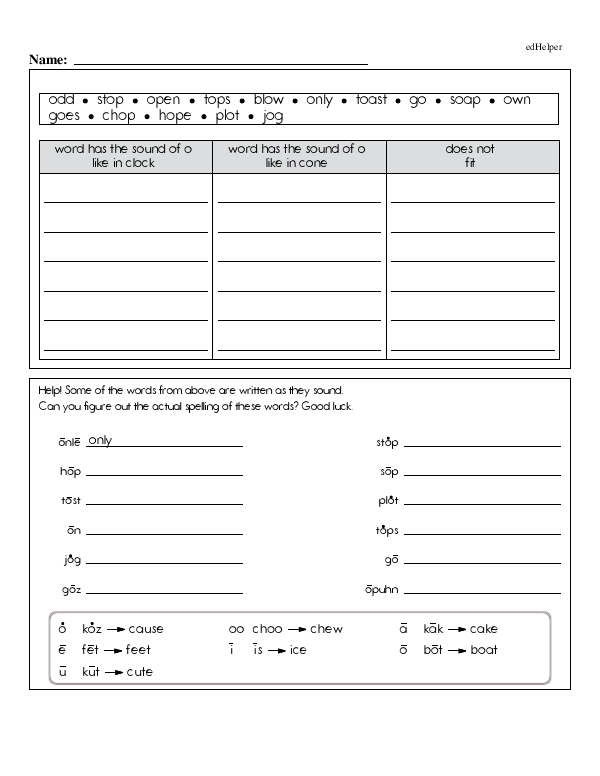
"Organizing and Writing Words According to Their Letter Sounds With Fill-in-the-Blank Phrases" is a worksheet that features multiple activities that help students work on letter sounds, word recognition, and vocabulary.
Activities include:
* Tables where students sort the words in a word bank into columns according to their letter sounds. For example, students might separate words according to A sounds like "glass" and "gate."
* Read words that are written phonetically and rewrite them with their correct spelling. For example, students would rewrite "tuhgEHthur" as "together."
* Fill words from a word bank into the blanks in a short passage, paying special attention not to fill in words that are purposely misspelled in the word bank.
Activities include directions or examples that enable students to get started independently. For example, each column is labeled in the sorting activity so students know what sounds they're looking for. A key of phonetic spellings is included in the activity where students have to spell words correctly, and example words are crossed out and filled in the blanks in each short passage.
Spelling and vocabulary can become tricky as students get older, as some letters make different sounds depending on the words they are in. It's important to give students plenty of practice developing their vocabulary and working with letter sounds to make them better readers and writers.
Allowing students to spell words the way they sound can be a helpful starting place. Write words how they sound and ask students to decode them by writing their correct spelling. They could also write their own phonetically spelled words and ask their classmates if they can figure out what word it is.
Students can sort words depending on the sounds a certain letter makes, like the letter O in "clock" and "old." You could also ask them to sort through a bank of words and identify which ones are spelled correctly and which ones are spelled incorrectly. Mix easy and difficult words like "bihlev" and "believe," which are easier to identify, as well as "great" and "greate," which are more difficult.
Organizing and Writing Words According to Their Letter Sounds With Fill-in-the-Blank Phrases
Organizing and Writing Words According to Their Letter Sounds With Fill-in-the-Blank Phrases
GRADES: