

"Patterns, Story Problems, and Puzzles Super Pack" is a worksheet that features a variety of grade-level appropriate activities that support the development of problem-solving skills.
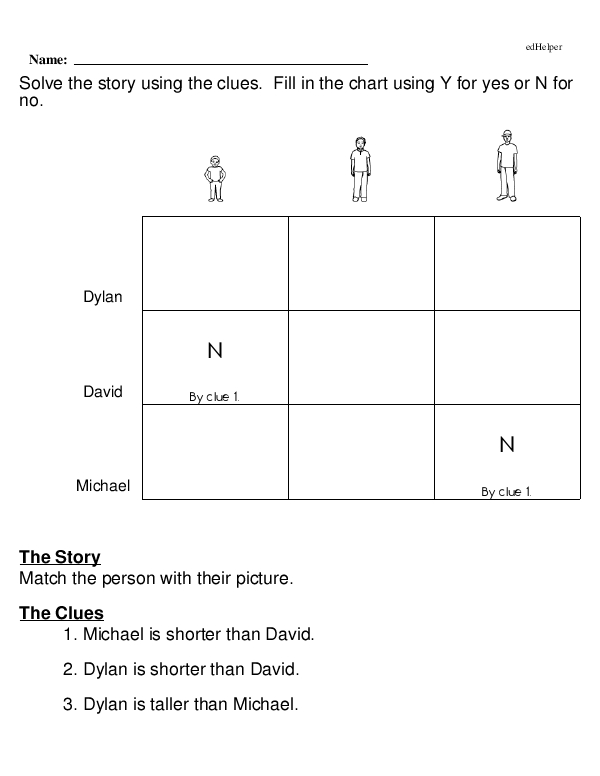
Word problems come with a story, clues, and a grid that students are able to fill in as they read the clues to find the answer. For example, one clue might be, "A boy likes reptiles." Students would mark a "Y" in the grid for the boys and an "N" in the grid for the girls. By the time they're done solving the clues in the grid, they will find the answer to the story.
Patterns make an appearance on the worksheets, with students writing numbers and letters in patterns that follow the same rule. Sudoku puzzles are also included, with some containing Sudoku Sums, so students can check their answers as they work.
Some grids encourage students to find the sums for given images and then figure out how much each image is worth. Regardless of the activity, students may encounter questions or problems involving addition, money, fractions, and other concepts.
Long-term success in reading and math is often determined by a student's ability and willingness to problem-solve. Having a variety of worksheets that focus on problem-solving skills gives teachers the ability to have students practice important skills as homework, group work, classwork, and more.
Step-by-step word problems can be especially powerful, as they help students learn how to walk through a problem to find the solution one step at a time. They can then apply that concept to other story problems they work on.
Puzzles and patterns can be great ways to support problem-solving skills. Students can figure out the next number or letter in a sequence, or they can figure out what number value should be associated with each picture in a picture equation.
If students are struggling or are feeling frustrated, allow them to work in pairs or small groups. You can also invite students to solve the problems they feel comfortable tackling and skip the rest. This prevents frustration, and it can tell you which types of problems students need more help with.
Patterns, Story Problems, and Puzzles Super Pack
Additional Educational Resources:
Algebraic Expressions Large Workbook - (Grade 6)
Using Bar Models: Addition and Subtraction Large Workbook - (Grade 2)
Quick Assessment - Solving Simple Inequalities: Exploring One- and Two-Step Inequalities
Quick Assessment - Fractions: Fraction Comparison and Easy Fraction Addition
Patterns, Story Problems, and Puzzles Super Pack
GRADES:
Additional Educational Resources:
Algebraic Expressions Large Workbook - (Grade 6)
Using Bar Models: Addition and Subtraction Large Workbook - (Grade 2)
Quick Assessment - Solving Simple Inequalities: Exploring One- and Two-Step Inequalities
Quick Assessment - Fractions: Fraction Comparison and Easy Fraction Addition