

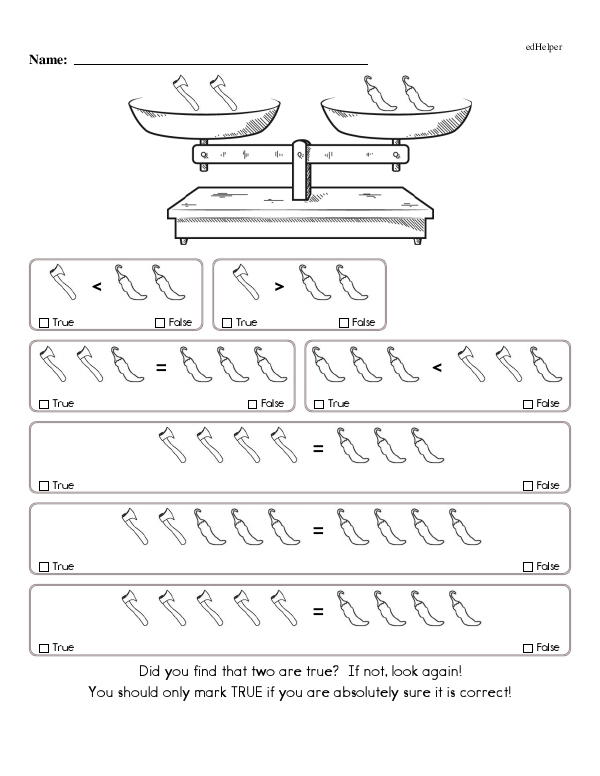
The worksheet "Pictures on a Scale: Using True-False Statements in Picture Equations" features a picture of a balance at the top. Then, the page is filled with picture equations that reflect what is displayed on the scale.
For example, the scale might show two flowers and two rabbits that have the same weight. Down below, students have to determine whether it's true or false that one flower equals two rabbits or whether one flower is greater than two rabbits. Sometimes the worksheet has directions at the top that read, "Look at the balance. What does it tell you? Write a sentence to explain." All worksheets finish with a clue like "Did you find two that are true? If not, look again!" so students can double-check their work.
Comparing and contrasting is an important mathematical skill that enables students to see how numbers and objects relate to each other. You can create an engaging and educational activity by inviting students to use their symbolic reasoning skills to determine whether equations are true or false.
For example, you might demonstrate that two pictures, like a police hat and a heart, are equal. Then, students can indicate whether the equation "one heart and two hats is less than three hats" is true or false.
A more difficult version of this activity might include multiple images on a scale. For example, an otter and two fish equal an otter, a dolphin, and a fish, so students can determine that one dolphin must equal one fish.
Students can solve these puzzles, but they can also create their own. Then, they can share them in pairs, or you can complete some together as a class.
Pictures on a Scale: Using True-False Statements in Picture Equations
Additional Educational Resources:
Number Bonds Large Workbook - (Grade 1)
Equations and Inequalities Large Workbook - (Grade 6)
Quick Assessment - Algebra Expressions and Equations Challenge: Combining Like Terms & Finding the Unknown
Quick Assessment - Algebra Foundations - Variables in Action: Building and Solving One-Step Equations
Pictures on a Scale: Using True-False Statements in Picture Equations
GRADES:
Additional Educational Resources:
Number Bonds Large Workbook - (Grade 1)
Equations and Inequalities Large Workbook - (Grade 6)
Quick Assessment - Algebra Expressions and Equations Challenge: Combining Like Terms & Finding the Unknown
Quick Assessment - Algebra Foundations - Variables in Action: Building and Solving One-Step Equations